What Fruit Is Good for Constipation? The Ones With Real Evidence and How to Eat Them
Kiwifruit and prunes have clinical trial evidence for constipation; pears provide fiber and sorbitol. Compare practical servings, tolerance, and when fruit alone may not be enough.
By WellTao · Published: · Editorial Policy
More articles in this topicTable of contents

The short version
The clearest trial evidence among fruits is for kiwifruit and prunes. A randomized trial (American Journal of Gastroenterology, 2021) compared two green kiwifruit a day, 100 g prunes a day, and psyllium over four weeks in adults with chronic constipation. All three groups improved on some measures; this trial does not establish the same evidence for pears. The NHS also recommends fruits containing sorbitol: apples, apricots, grapes (and raisins), raspberries, and strawberries.
Two boundaries before the recipes. Fruit helps most with the dry, hard-stool, low-fiber kind of constipation; if your problem is straining and incomplete emptying with a stool that isn’t hard, fruit plays a minor role. And fruit can’t replace meals — eating only fruit actually lowers your total fiber intake.
Will fruit help yours
- Good fit: hard, pellet-like stools with a recent history of skimping on fruit, vegetables, and water. Fruit’s water, sorbitol, and fiber address exactly this.
- Limited help: stool that isn’t hard but won’t come out or never feels finished, or bloating that overshadows constipation. The issue there is propulsion or coordination — fruit is a supporting player.
- Go carefully: if you’re prone to diarrhea or have IBS, sorbitol and fructose can trigger symptoms — start with small amounts. If you manage blood sugar, watch the portions; exact numbers are below.
What modern medicine says
Fruit works through three components acting together. First, sorbitol — a slowly absorbed sugar alcohol that reaches the colon and holds water in the stool; pears, apples, apricots, and prunes are all high in it. Second, fiber — kiwifruit’s soluble fiber has exceptional water-holding capacity, and prunes’ insoluble fiber adds bulk. Third, plain water — most fresh fruit is over 80% water by weight.
Why whole fruit beats juice. Juicing strips most of the fiber and concentrates the sugar and sorbitol. Whole fruit gives a flatter blood-sugar curve and better satiety. If you do want juice, prune juice is the only one with randomized-trial support — details in what juice is good for constipation.
Dose matters more than variety. The effective amounts in studies are specific: two kiwifruit a day, 50–100 g of prunes. A bite or two for the taste of it won’t reach that; but doubling up isn’t better either — too many prunes brings bloating and diarrhea. A review of dried plum composition and effects attributes the effect to a combination of sorbitol, fiber, and phenolic compounds — not any single ingredient, which is why sorbitol powder isn’t a straight substitute for prunes.
How Chinese medicine understands it
In the traditional Chinese medicine (TCM) framework, fruit selection isn’t about nutrient tables — it’s about “nature and flavor” and texture. The same constipation-friendly fruits carry different traditional properties: pears and mulberries are said to “generate fluids and moisten dryness,” suiting a parched intestine; a banana is two foods depending on ripeness — ripe it moistens, unripe it binds; kiwifruit and dragon fruit run cool in nature, moistening but potentially “hampering the Spleen” in someone whose digestive engine runs weak — the moistening never arrives because the bloating gets there first. This framework answers a question nutritional analysis doesn’t: for the same fruit, who should eat more, who should eat it cooked, who should rotate away.
This traditional classification is an empirical model, not modern nutritional taxonomy — but the two echo each other more than you’d think: what tradition calls “moistening” tends to map to high water, sorbitol, and soluble fiber, and what it calls “burdensome to the Spleen” tracks with gas-forming, high-fructose patterns (for an overview of TCM and the state of its evidence, see NCCIH’s TCM page).
Choosing fruit by constipation pattern:
- The dry kind (hard stool, dry mouth, dry skin): traditionally, pears, grapes, and mulberries — the “generate fluids and moisten the intestine” group — fit, matching the daily-care direction for yin-deficiency constitution tendencies. Dragon fruit and kiwifruit work too.
- The underpowered kind (effortful passage, cold hands, fatigue): traditionally, cool-natured fruits like kiwi and pear in large raw quantities may “hamper the Spleen” — eat them at room temperature, not on an empty stomach, or cooked. Warm-natured dried fruits like red dates and longan suit the direction better. This matches yang-deficiency and qi-deficiency tendencies.
- The bloated-stuck kind (bloating over blockage, syncs with mood): fruit isn’t the main lever, and large amounts of high-gas fruit (apples and pears in quantity) can worsen the bloating — eating rhythm and stress are the real battleground, covered in can stress make you constipated.
The link runs one way: a yang-deficiency leaning means watching the volume of cold raw fruit, not that “pear helped my constipation” proves a constitution. The same person can carry a mix of patterns, shifting with season and state; formal differentiation takes an in-person TCM practitioner.
Everyday ways to eat them
Turning study doses into daily habits:
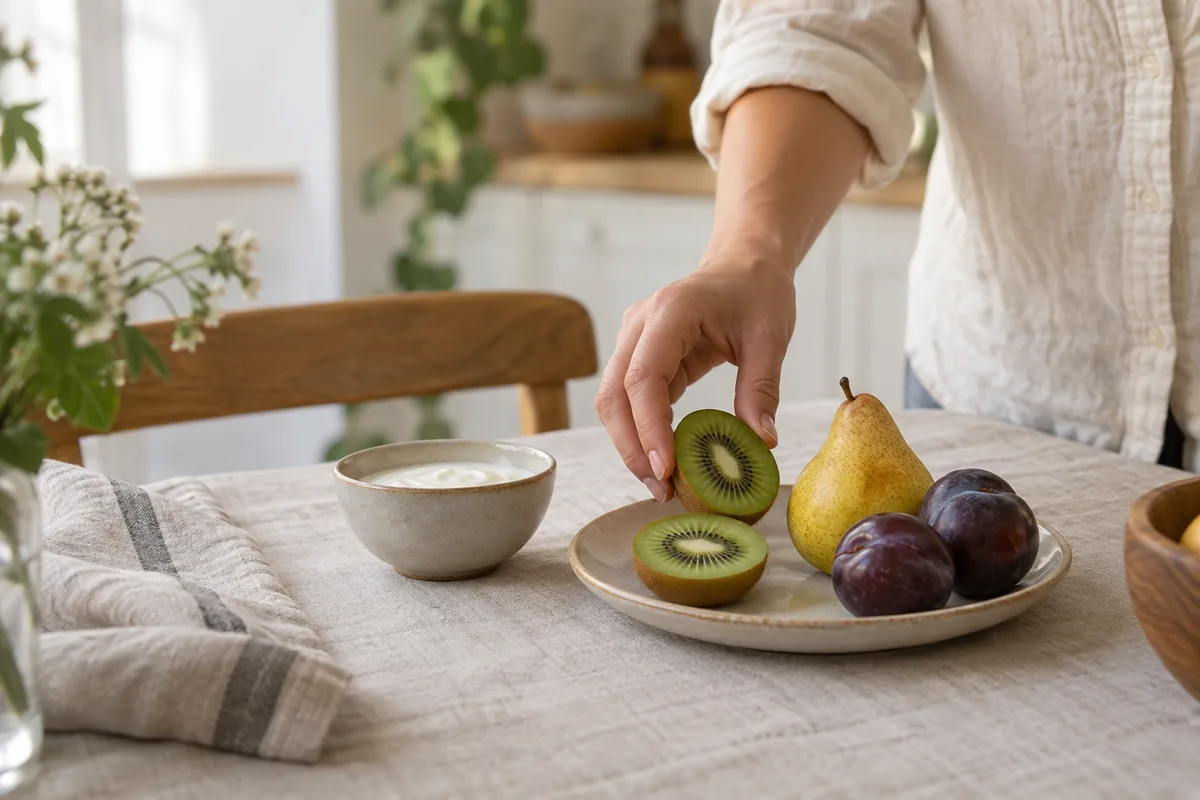
- Kiwifruit: two a day was the amount studied in one four-week trial. Eat them with or after a meal if that suits you; wash the skin well, or halve and scoop if you prefer. Individual results vary.
- Prunes: start at 5–6 (about 50 g) a day, cap at 100 g. Soaking in warm water softens them for easier digestion; on prune days, add one extra glass of water.
- Pears and apples: skin on. The fiber concentrates in and under the skin — peeling throws half the active ingredient away.
- Choose a time that suits you. Having fruit with breakfast is one practical option; no particular time is established as best for constipation.
- Juice is the fallback, not the default: what juice is good for constipation.
TCM methods
The five categories below work alongside the fruit habit, each marked with the constitution tendencies it suits. Everything in the food section is a food-therapy use of culinary ingredients; if you intend to use them as medicinal herbs, consult a licensed TCM practitioner.
Acupressure and self-massage
Best done after breakfast, overlapping the fruit window. Press with a fingertip pad, firm enough for a mild, bearable ache:
- Tianshu (ST25): about three finger-widths to either side of the navel, 60 seconds per side. Traditionally regulates the Large Intestine’s conduction — pairs naturally with a fruit breakfast.
- Zusanli (ST36): about four finger-widths below the outer knee hollow, one finger-width out from the shinbone, 60 seconds per side. Traditionally supports the Spleen and Stomach — a good daily point for people who bloat on fruit.
- Zhigou (TE6): back of the forearm, four finger-widths above the wrist crease, between the two bones, 60 seconds per side. Traditionally the empirical point for constipation; pressing before a bathroom visit is the traditional use.
- Belly rub: palm on abdomen, slow strokes along the colon’s path (lower right → upper right → upper left → lower left) for 3–5 minutes. Direction matters.
Cautions: pregnant women should not press abdominal points or do the belly rub; skip over unhealed abdominal surgery or hernias; stop if it hurts. If you lean yang-deficient, warm your hands first — rub them together before touching your abdomen.
Food therapy
Chinese home-style track (ingredients at Asian supermarkets or online):
- Steamed pear with goji berries: core one snow pear, fill with 5 g goji berries, steam over water for 15 minutes, eat warm. Steaming removes the raw-cool edge while keeping the moistening effect — suits yang-deficiency leanings and autumn-winter dryness; the dry kind can have one every other day.
- Banana with black sesame: slice one fully ripe banana, sprinkle with 10 g toasted black sesame powder. Both traditionally moisten the intestine — a simple afternoon snack; halve the banana if you manage blood sugar.
- Mulberry infusion: steep 10 g dried mulberries in warm water for 20 minutes, then eat fruit and liquid together. Traditionally mulberries nourish yin and generate fluids — the dry kind’s drink; skip during diarrhea.
Western everyday track:
- Prune overnight oats: 4 chopped prunes, 40 g oats, 150 g unsweetened yogurt, refrigerated overnight. The studied “prune plus fiber” combination as breakfast; with blood-sugar concerns, swap the yogurt for unsweetened soy milk and cut to 3 prunes.
- Baked apple with cinnamon: core and chop one apple, bake at 180°C for 20 minutes, dust with cinnamon. Baked apple’s pectin is gentler and easier to absorb — yang-deficiency leanings included. A classic, mild, gut-friendly dessert in Western home tradition.
Emotional care
For stress-pattern constipation, fruit is a supporting act. If your constipation reliably appears in busy weeks and lifts on weekends, work the rhythm and stress first — can stress make you constipated. One thing you can do today: when you eat the fruit, sit down and look at it — five screen-free minutes of eating is itself a micro-rest for anyone running tense.
Movement
A 10-minute walk after breakfast, at a pace where you can talk in full sentences. Breakfast, fruit, and a walk are three pro-motility factors stacking; any one alone is weaker. In the traditional exercise set, the baduanjin (“eight brocades,” a slow sequence of eight gentle standing exercises) move “raise one arm to regulate the Spleen and Stomach” targets digestion — 4–6 repetitions morning and evening. If you lean qi-deficient, start with a 5-minute walk; yin-deficiency leanings stop at a light glow.
Sleep and daily rhythm
- Fix fruit at breakfast or lunch — in the evening, slowed digestion plus a fruit load means more overnight fermentation and gas.
- Fix the prune days (say, Monday, Wednesday, Friday) into a predictable rhythm — the gut learns to anticipate.
- Let refrigerated fruit come to room temperature before eating — yang-deficiency leanings especially.
Fruit picker table
| Fruit | Key components | Daily amount | Notes |
|---|---|---|---|
| Kiwifruit | Soluble fiber | 2 | Most balanced evidence, least bloating |
| Prunes (dried) | Sorbitol + fiber | 50–100 g | Overdoing it brings bloating and diarrhea; start low |
| Pear | Sorbitol + pectin | 1, skin on | Cool in nature by tradition; steam it if you run cold |
| Apple | Sorbitol + pectin | 1, skin on | Chew thoroughly |
| Dragon fruit | Fiber + seeds | Half | Red-fleshed types tint stool red — don’t mistake it for blood |
| Banana (ripe) | Soluble fiber | 1 | Unripe bananas can worsen constipation |
How to use: try one change at a time and keep a note of your response. If a fruit worsens symptoms, reduce or stop it rather than adding more.
How long until you see improvement
Trials assessed fruit over several weeks, but they do not predict when an individual will improve. If constipation persists or worsens despite self-care, discuss the next steps with a clinician.
When to see a doctor
- Blood in the stool (excluding dragon-fruit tinting, which clears within two days of stopping — persistence is a warning sign), unexplained weight loss, or persistent fatigue;
- Persistent or worsening abdominal pain, vomiting, fever, or inability to pass gas — prompt care;
- A sudden change in bowel habits, especially new after age 40;
- Constipation that persists despite self-care, worsens, or keeps disrupting daily life.
If you have IBS, diabetes, or take medication that can cause constipation, check with a doctor or registered dietitian before changing fruit types and amounts. This article is general health education and can’t replace a doctor’s diagnosis or individualized advice.
Common questions
Do bananas help or not?
Ripeness decides. A ripe banana (brown-spotted) is mildly softening; an underripe one carries starch and tannins that can worsen constipation. Given ripe kiwis and prunes exist, bananas aren’t worth agonizing over.
What about trendy picks like avocado and dragon fruit?
Their fiber content is real, and they’re fine everyday fruits — but they lack the controlled-trial backing that kiwifruit and prunes have. Treat them as part of a balanced diet, not as targeted tools.
Can fruit replace laxatives?
No. Fruit suits mild, common sluggishness; situations that call for medication (post-surgery, opioid-induced constipation) need medical guidance. If you already use laxatives regularly and want to transition to a food approach, plan the taper with your doctor.
For juices, read what juice is good for constipation; for the whole dietary frame, see what foods help with constipation and the constipation hub.
Same kiwi, different results — the reason is the pattern
Fruit works best for the dry, hard-stool kind of constipation; when the problem is weak propulsion or incomplete emptying, fruit alone rarely suffices. The free constitution test shows your tendencies from a traditional wellness perspective and pairs well with the serving guide in this article. It's a self-observation tool, not a medical diagnosis.
References5 sources
- 01
The American Journal of Gastroenterology (PubMed / NIH)
- 02
Critical Reviews in Food Science and Nutrition (PubMed / NIH)
- 03
UK National Health Service (NHS)
- 04
U.S. National Institute of Diabetes and Digestive and Kidney Diseases (NIDDK / NIH)
- 05
U.S. National Center for Complementary and Integrative Health (NCCIH / NIH)
Personalized guidance
Use the app for constitution-friendly ideas and structured plans when available.
Download the App
Get personalized TCM health recommendations