Stretches and Yoga for Constipation: Four Gentle Moves and the Honest Evidence
Twists and knees-to-chest moves help by gently compressing and releasing the abdomen, and yoga's evidence is limited but safe. How to do the four moves, when to do them, who shouldn't, and where stretching really sits in constipation care.
By WellTao · Published: · Editorial Policy
More articles in this topicTable of contents
The short version
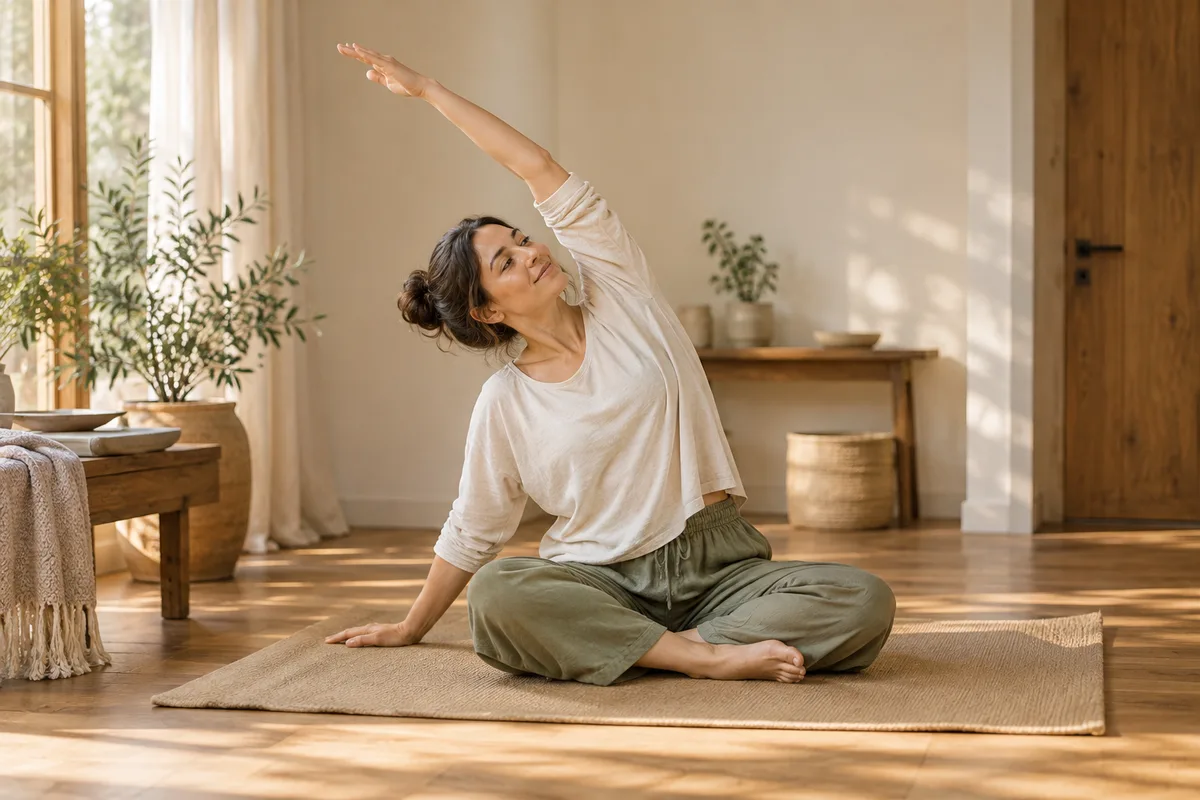
Evidence that stretching directly improves constipation is limited. Gentle movements such as knees-to-chest, a supine twist, cat-cow, and child’s pose may be comfortable ways to move and relax; they have not been shown to physically push stool through the colon. You can try a short routine at a time that feels comfortable.
Set expectations honestly: stretching is a supporting measure, not the main event — NIDDK’s everyday measures center on diet, fluids, activity, and toilet routine. Direct trial evidence for yoga in constipation is thin; a randomized trial in older adults found yoga practice improved digestive health and sleep quality, but small samples and design limits mean you can’t extrapolate to “yoga treats constipation.”
Is stretching for you
- Good fit: sedentary days, morning stiffness, constipation with bloating — stretching addresses both the “not moving” and the “stuck gas” sides.
- Good as an add-on: you’re already changing diet and exercise and want one more low-barrier habit.
- Not now: acute abdominal pain, bloating to the point of pain, mid-to-late pregnancy (the abdominal-compression moves), acute lumbar disc flares, or unhealed abdominal surgery — talk to a doctor first in all of these.
What modern medicine says
Stretching changes body position and abdominal movement, while breathing moves the diaphragm. These facts do not establish that the movements massage the organs or improve constipation; any benefit may vary.
The evidence, stated plainly. High-quality randomized trials of yoga for constipation itself are scarce; most existing research targets digestive function in older adults or people with IBS, with positive but small-sample results. NCCIH’s yoga overview characterizes yoga as a safe, low-intensity activity for most people, with better support for stress-related complaints — and stress and constipation often travel together. So stretching’s honest placement is: a low-risk activity for many people when adapted to their abilities, but not a proven constipation treatment.
What matters more than stretching. If your activity level is near zero, walk first — walking has the stronger evidence. Stretching’s value is its low barrier, home setting, and simultaneous effect on bloating and stress. It complements exercise; it doesn’t replace it.
How Chinese medicine understands it
The traditional Chinese exercise arts — baduanjin (“eight brocades”), the Five Animal Frolics, and the various stretching-and-massage routines — were designed to “move qi and blood and keep the bowels communicating.” Their place in the traditional system is distinctive: not building fitness, but “guiding qi into harmony and drawing the body into suppleness” — slow, directional stretches and twists, coordinated with breath, to restore the rhythm of qi’s movement. Modern yoga twists look much like the traditional moves, and the reason is unsurprising: there’s only one anatomy, and the physical effect of compressing and releasing the abdomen doesn’t change with the cultural frame around it.
In that frame, twisting moves “dredge the Liver’s qi and open the triple burner” — the Liver (a functional concept, not the organ) governs the free flow of the system’s rhythm, and when qi flows, the bowels descend. Forward folds “draw qi downward.” This is a traditional empirical model; the modern reading (compression, diaphragm movement, parasympathetic activation) speaks a different language, but the prescribed practice is nearly identical (for an overview of the framework’s boundaries, see NCCIH’s TCM page).
By constitution tendency:
- Qi-stagnation constitution tendencies: prioritize twists and chest-openers with long slow exhales — physical release and emotional release feed each other. For you this is the main event, not a support act.
- Qi-deficiency constitution tendencies: halve the range and the reps; the right aftertaste is relaxed, not tired.
- Yang-deficiency constitution tendencies: practice in a warm room, not on a cold morning floor; warm your hands and feet first in winter.
- Yin-deficiency constitution tendencies: do the relaxing moves before bed (child’s pose, supine twist) and skip strong holds; the goal is settling, not sweating.
The link runs one way: tendencies shape the practice, not that “twists feel good” proves a constitution. Patterns mix and shift; formal differentiation takes an in-person TCM practitioner.
The four moves
Hold each move for 5–8 slow breaths; the full set takes about 10 minutes. Do it on an empty stomach in the morning or before bed — never within an hour after a meal.
1. Knees-to-chest (a wind-relieving variant). Lie on your back, hug both knees to your chest with hands clasped around your shins, lower back flat. Rock gently side to side. This is the most direct abdominal-compression move of the four, and the most immediately helpful on bloated days.
2. Supine twist. On your back, arms out in a T, knees together, drop both knees to the left while turning your head right; hold 5 breaths, then switch sides. The twist alternately compresses the ascending and descending colon.
3. Cat-cow. On all fours: inhale, arch the spine and lift the head (cow); exhale, round the spine and draw the belly in (cat) — 8–10 slow cycles. The spinal flexion-extension cycles abdominal pressure rhythmically.
4. Child’s pose. Kneel, sit back toward your heels, fold forward with arms extended or resting by your sides, and stay for 8–10 deep breaths. This is the settling position, where diaphragmatic breathing is most pronounced.
Safety floor: any move that hurts, exit it; if you get dizzy, rise slowly; in pregnancy, after abdominal surgery, with a hernia, or with lumbar disc issues, clear the practice with a doctor first.

TCM methods
The five categories below pair with the stretching, each marked with the constitution tendencies it suits. Everything in the food section is a food-therapy use of culinary ingredients; if you intend to use them as medicinal herbs, consult a licensed TCM practitioner.
Acupressure and self-massage
Post-stretching, when the body is warm and qi is moving, is the best moment. Press with a fingertip pad, firm enough for a mild, bearable ache:
- Tianshu (ST25): about three finger-widths to either side of the navel, 60 seconds per side, timed with slow exhales — the abdominal wall softens as you breathe out, letting the pressure sink in.
- Zhigou (TE6): back of the forearm, four finger-widths above the wrist crease, between the two bones, 60 seconds per side. Traditionally the empirical constipation point.
- Zusanli (ST36): about four finger-widths below the outer knee hollow, one finger-width out from the shinbone, 60 seconds per side. Traditionally supports the Spleen and Stomach — the lower-body complement to the abdominal work.
- Belly rub: palm on abdomen, slow strokes along the colon’s path (lower right → upper right → upper left → lower left) for 3–5 minutes; direction matters. Full technique in how to massage your stomach.
Cautions: pregnant women should not press abdominal points or do the belly rub; skip over unhealed abdominal surgery or hernias; stop if it hurts. Qi-deficiency leanings halve the pressure.
Food therapy
Chinese home-style track (ingredients at Asian supermarkets or online):
- Warm water, then a warm breakfast: a glass of warm water right after the routine, then a hot congee breakfast — tradition holds that yang rises with the morning, and warm food supports the transformation; yang-deficiency leanings especially.
- Chinese yam and red date congee: 100 g cubed Chinese yam (shan yao), 3 red dates, and 40 g rice simmered for 30 minutes. Traditionally supports the Spleen and boosts qi — the practice day’s breakfast; qi-deficiency leanings can keep it in regular rotation.
- Honey water: 1 teaspoon honey in 250 ml warm water on waking. Traditionally moistens the intestine — suits the dry kind; not for blood-sugar management, never for infants under one.
Western everyday track:
- Oat breakfast: 50 g oats simmered soft in 200 ml milk, topped with half a skin-on pear, chopped. Eaten 30 minutes after the routine — stretching, warm water, and a high-fiber breakfast make the morning trio.
- Overnight chia cup: 1 tablespoon chia seeds, 150 ml milk or soy milk, a handful of blueberries, refrigerated overnight. Soluble fiber plus water — a gentle choice for yin-deficiency leanings.
Emotional care
Treat the routine as the day’s “reset point”: 10 minutes, no phone, attention on breath — inhale “soften,” exhale “sink.” Qi-stagnation leanings benefit most: as the body opens, the breath deepens on its own, which is the everyday version of what the tradition calls “soothing the Liver” — no extra knowledge required. If your mind keeps wandering, don’t fight it — count breaths, and restart when you lose count.
Movement
Stretching and walking complement each other: stretching covers local abdominal compression and release; walking covers whole-body volume and overall gut motility. Doing both means neither has to be intense — 10 minutes of stretching plus a 20-minute walk daily is a sustainable pairing. The baduanjin move “raise one arm to regulate the Spleen and Stomach” can slot into the morning flow, 4–6 repetitions. Qi-deficiency and yang-deficiency leanings warm up with a walk before stretching.
Sleep and daily rhythm
- Fix the morning sequence: wake → warm water → stretches → breakfast → bathroom window. Five events in a fixed order, and over time the routine may become easier to maintain.
- Before bed, child’s pose and supine twist for 5 breaths each — wind down into sleep; sleep itself feeds bowel rhythm.
- Fixed time beats duration: 10 minutes daily outperforms 40 minutes once on the weekend.
Ten-minute morning routine card
Print or save this; follow it for a week:
- On waking, one glass of warm water (about 250 ml);
- Knees-to-chest, 5–8 breaths;
- Supine twist, 5 breaths each side;
- Cat-cow, 8–10 cycles;
- Child’s pose, 8–10 deep breaths;
- Tianshu and Zhigou, 60 seconds each side;
- Breakfast, then a 15-minute bathroom window.
After a week, check: is the morning urge getting more regular? Is the bloating easing? No change in two weeks — keep the stretching (it’s still worth it for stiffness and stress), and move the constipation effort toward diet and a medical check.
How long until you see improvement
- Bloating: notice whether symptoms change; relief and timing vary.
- Morning urge: observe whether a breakfast and bathroom routine helps; there is no fixed timeline.
- As a constipation support: judge the combined effect with diet and exercise at four to six weeks; stretching alone won’t fix constipation.
When to see a doctor
- Worsening pain or sharp pain during practice — stop and get evaluated;
- Blood in the stool, unexplained weight loss, or persistent fatigue;
- Vomiting, fever, or inability to pass gas — prompt care;
- A sudden change in bowel habits, especially new after age 40;
- Four to six weeks of stretching, diet, and exercise with no improvement.
If pregnant, clear the practice with your maternity provider first. This article is general health education and can’t replace a doctor’s diagnosis or individualized advice.
Common questions
Yoga classes or stretching at home?
For constipation specifically, 10 targeted minutes at home is enough. A class adds whole-body work and community — if you go, tell the instructor your goal and skip strong core work and deep abdominal-compression poses.
When is the best time?
An empty stomach in the morning — the gut is most responsive after the overnight fast, and the routine stacks with warm water and breakfast into a complete morning sequence. Before bed, the same moves lean toward relaxation and sleep. Both slots are fine to keep.
Is stomach gurgling during twists normal?
Yes — that’s gas and contents shifting under the pressure change, which means the compression is reaching the gut. Gurgling with pain is not normal; stop.
For the whole-body exercise plan, read exercises for constipation; for massage technique, how to massage your stomach; the full framework is in the constipation hub.
When should stretching happen for best effect?
Some do best with an empty-stomach morning routine; others need the bedtime wind-down — the pattern of your constipation decides what stretching is for. The free constitution test shows your tendencies from a traditional wellness perspective, and pairs well with the move-by-move guide in this article. It's a self-observation tool, not a medical diagnosis.
References4 sources
- 01
U.S. National Center for Complementary and Integrative Health (NCCIH / NIH)
- 02
Journal of Bodywork and Movement Therapies (PubMed / NIH)
- 03
U.S. National Institute of Diabetes and Digestive and Kidney Diseases (NIDDK / NIH)
- 04
U.S. National Center for Complementary and Integrative Health (NCCIH / NIH)
Personalized guidance
Use the app for constitution-friendly ideas and structured plans when available.
Download the App
Get personalized TCM health recommendations