Exercises to Help Constipation: Walking, Core Work, and Breathing — With Actual Plans
Regular movement is a first-line daily measure for constipation, but the type and timing decide whether it works. The mechanism, a plan that starts at 10 minutes of walking a day, the best timing, and the one thing sedentary people should fix first.
By WellTao · Published: · Editorial Policy
More articles in this topicTable of contents
The short version
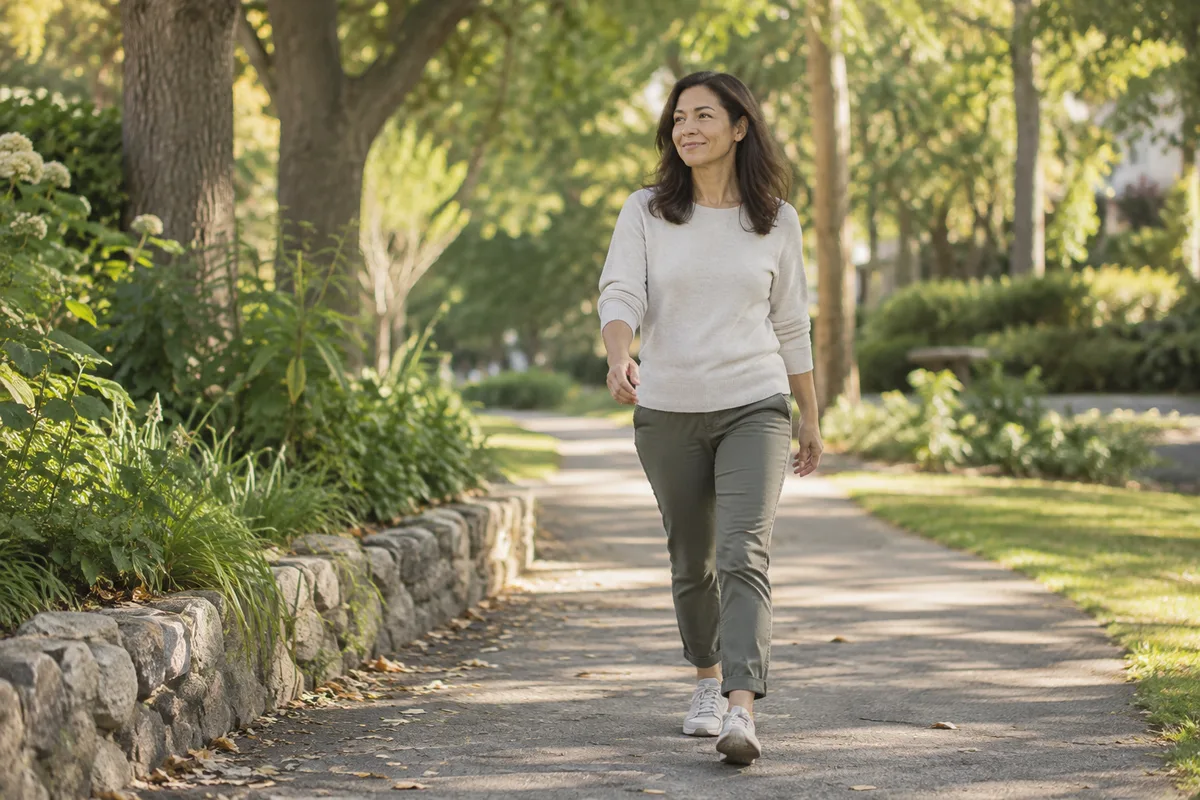
For constipation, a practical starting point is regular, moderate everyday movement, rather than intense training: regular physical activity is a reasonable place to start; a daily walk at a comfortable pace is one practical option. The NHS puts it plainly: a daily walk or run helps keep bowel movements regular; avoid long stretches of sitting or lying. NIDDK likewise lists regular physical activity as part of everyday constipation management.
Two things make it work. Timing beats intensity: light activity within 30 minutes after a meal rides the gastrocolic reflex. And starting beats sustaining: people who begin at 10 minutes outlast people who begin at 40. Already exercising but still constipated? Read the type-and-timing part below.
Is sitting your factor
- Very likely: six-plus hours of continuous sitting daily (desk work, long drives), almost no walking, and constipation that started or worsened when life got sedentary.
- Partly: you exercise regularly but the constipation persists. Check the timing — is it all in the evening, far from meals? The gut’s motility window opens after eating.
- Probably not the main one: normal activity levels, with constipation that tracks diet or mood instead. Exercise is then a supporting act — the main lever is in what foods help with constipation or can stress make you constipated.
What modern medicine says
Movement pushes the gut through two mechanisms. One is mechanical: upright activity and abdominal-muscle motion rhythmically jostle the colon, helping residue travel. The other is neural: exercise modulates the autonomic nervous system, which runs colon motility. A 2025 systematic review of the gut-exercise link (World Journal of Gastroenterology) found regular moderate activity associated with improvement across several gut functions, and prolonged sitting associated with higher constipation risk.
Why sitting is its own factor. People on bed rest or in long sedentary stretches show measurably longer colonic transit — not in the vague sense of “unfit people are unhealthy,” but in the direct sense that less movement means less physical stimulation of the bowel. Constipation in bedridden patients and after long flights follows the same logic.
Moderate activity is a practical starting point; harder exercise may cause gut symptoms for some people. High-intensity exercise (marathon training, for instance) diverts blood toward muscles, and some people get gut symptoms from it. The doses that worked in constipation research are all moderate — brisk walking, jogging, calisthenics. Twenty to thirty minutes a day, light sweat, able to talk in full sentences: that’s the target zone.
Timing: after meals may suit some people. Eating can stimulate colonic activity, and a gentle walk after a meal is one practical way to build movement into the day. There is not enough evidence to call it more effective for constipation than other activity times.
How Chinese medicine understands it
In the traditional Chinese medicine (TCM) framework, bowel movements are driven by “qi”: Spleen qi lifts the refined products of digestion upward, while Stomach and Large Intestine qi conduct residue downward — one rise, one descent, completing the cycle. Where does qi come from? The tradition’s answer is “movement generates yang”: physical activity is itself a source of qi, with muscular motion driving qi’s ascent and descent. The flip side is “prolonged sitting injures qi” — stay still long enough and the motive force idles, weakening the push. That is the same observation as the modern “sedentary people have longer colonic transit,” in two languages.
The traditional exercise arts — baduanjin (“eight brocades”) and the Five Animal Frolics — were designed in part to keep this production line running. The traditional exercises aim somewhere different from modern fitness: not muscle mass or heart-rate zones, but “moving qi” — specific stretches, twists, and breathing coordinated to route qi along its proper paths. The baduanjin move “raise one arm to regulate the Spleen and Stomach” is one arm up, one pressing down, alternately stretching the two sides of the trunk — a direct action on the middle. This is a traditional empirical model, not an equivalent of modern exercise physiology (for an overview, see NCCIH’s TCM page).
By constitution tendency, the starting point and the ceiling both differ:
- Qi-deficiency constitution tendencies: start with 5–10 minutes of flat walking, stopping at mild warmth, adding a little each week. High intensity out of the gate backfires — the budget is tight, and overspending exercise is worse than none.
- Yang-deficiency constitution tendencies: favor outdoor daytime activity in the sun; skip fasted early-morning cold workouts; keep the waist and abdomen warm in autumn and winter.
- Qi-stagnation constitution tendencies: exercise’s mood-untying value equals its bowel value — pair the walk with long, slow exhales and walk the day’s tension off.
- Yin-deficiency constitution tendencies: don’t chase heavy sweat — tradition counts sweat as fluid loss, and heavy sweating can leave the stool drier. A light sheen is the limit.
The link runs one way: tendencies change the starting dose, not that “exercise didn’t fix my constipation” proves a constitution. Patterns mix and shift; formal differentiation takes an in-person TCM practitioner.
Everyday exercise plan
An executable ramp, week by week:
Weeks 1–2: establish the post-meal walk.
- 10 minutes of walking after breakfast or dinner daily, flat ground, at a talkable pace.
- Desk workers: stand and move for 2–3 minutes every 45–60 minutes — water refills, stairs. Interrupting continuous sitting matters more than one big session.
Weeks 3–4: add volume and type.
- Extend the post-meal walk to 15–20 minutes; add a 5-minute walk after lunch.
- Twice a week, light core work: supine leg raises (alternating legs, 10 each) and planks (from 20 seconds up) — abdominal muscles contribute to the pressure you need on the toilet.
Week 5 onward: fix it as habit.
- 30 cumulative minutes of walking a day (three segments count); keep the twice-weekly core.
- Add one aerobic activity you enjoy (jogging, cycling, swimming, dancing) once or twice a week — adherence beats the choice of sport.
TCM methods
The five categories below complement the modern exercise plan, each marked with the constitution tendencies it suits. Everything in the food section is a food-therapy use of culinary ingredients; if you intend to use them as medicinal herbs, consult a licensed TCM practitioner.
Acupressure and self-massage
Right after exercise, while circulation is up, is a good moment. Press with a fingertip pad, firm enough for a mild, bearable ache:
- Zusanli (ST36): about four finger-widths below the outer knee hollow, one finger-width out from the shinbone, 60 seconds per side after exercise. Traditionally the “strengthening point,” supporting the Spleen and Stomach — also the classic for post-exercise recovery.
- Tianshu (ST25): about three finger-widths to either side of the navel, 60 seconds per side. Traditionally regulates Large Intestine conduction — stacked right after a walk for combined effect.
- Shangjuxu (ST37): about three finger-widths below Zusanli, just off the shinbone. Traditionally the Large Intestine’s lower confluent point — press it in one continuous line with Zusanli, 60 seconds per side.
- Zhigou (TE6): back of the forearm, four finger-widths above the wrist crease, between the two bones, 60 seconds per side. Traditionally the empirical constipation point — easy to press at your desk between sitting bouts.
Cautions: pregnant women should not press abdominal points; stop if it hurts. Qi-deficiency leanings halve the pressure; yin-deficiency leanings rehydrate after pressing.
Food therapy
Exercise-day eating focuses on rehydration and refueling without load.
Chinese home-style track (ingredients at Asian supermarkets or online):
- Chinese yam and millet congee: 100 g cubed fresh Chinese yam (shan yao) and 40 g millet simmered in 500 ml water for 30 minutes, eaten warm after exercise. Traditionally supports the Spleen and boosts qi with a neutral nature — gentle replenishment for qi-deficiency leanings; yang-deficiency leanings add two slices of ginger.
- Sweet potato and red date congee: 100 g sweet potato, 3 red dates, and 40 g rice simmered into porridge. Traditionally supports the Spleen and “widens the intestines” — a gentle exercise-day dinner staple.
- Walnut-sesame porridge: 15 g each walnuts and black sesame, ground, simmered with 30 g rice into a porridge — full recipe in walnut-sesame porridge. Traditionally moistens the intestine — a post-exercise snack for the dry kind; skip during diarrhea.
Western everyday track:
- Banana peanut-butter toast: a slice of whole-grain bread, 1 tablespoon peanut butter, half a ripe banana sliced. Within 30 minutes after exercise — fiber and energy together; with nut allergies, use sunflower-seed butter.
- Roasted sweet potato with yogurt: 200 g roasted sweet potato with 100 g unsweetened yogurt. Gentle carbs plus fermented dairy after exercise; yang-deficiency leanings eat the potato warm and let the yogurt come to room temperature.
Emotional care
Exercise is the rare two-for-one: it promotes gut motility and directly lowers stress — and stress is itself a common constipation driver. If you lean qi-stagnant, schedule the walk after the day’s biggest pressure point (get off the commute one stop early) and actually walk it: no calls, no podcasts, let the nervous system shift gears. On days when motivation is zero, use the floor rule: walk downstairs for 5 minutes and come back. Most days you’ll finish the planned route — lowering the start-up bar is a standard behavior-design trick.
Movement (the traditional exercise)
In the traditional set, the baduanjin move “raise one arm to regulate the Spleen and Stomach” targets digestion specifically. At a press briefing on spleen-stomach disorders hosted by China’s National Administration of Traditional Chinese Medicine (in Chinese), experts explained what the move does and how to perform it. How: stand, raise the left hand palm-up slowly overhead while pressing the right hand down to the hip, stretching both sides of the trunk, hold briefly, then switch — 4–6 repetitions per side, morning and evening. Gentle, to the point of feeling the stretch, not the amplitude. Yin-deficiency leanings don’t need heat or sweat — form is enough; with knee or hip issues, reduce the squat depth.
Sleep and daily rhythm
- Bind walks to meals — “attach to an existing habit” beats “create a new one”: 10 minutes after breakfast, 10 after dinner. Start with just those two.
- Interrupt sitting every 45–60 minutes with 2–3 minutes of movement; breaking up continuous sitting matters more than one full workout.
- No vigorous exercise after 9 p.m. — protect sleep, since poor sleep drags the gut down with it.
One-week starter plan
Print or screenshot; tick each day:
| Day | Post-meal walk | Sitting interruptions | Core |
|---|---|---|---|
| Mon | 10 min after breakfast | Every 60 min | — |
| Tue | 10 min after breakfast | Every 60 min | Leg raises, 2 sets |
| Wed | 10 min after dinner | Every 45 min | — |
| Thu | 15 min after breakfast | Every 60 min | Planks, 2 sets |
| Fri | 15 min after breakfast | Every 60 min | — |
| Sat | 20 min after lunch | Free | — |
| Sun | 10 min after any meal | Free | Leg raises, 2 sets |
The rule: completion rate beats intensity — A manageable plan may be easier to maintain than one that feels too ambitious. Under 50% for two weeks running? Halve the plan and restart. Don’t quit.
How long until you see improvement
- After a post-meal walk: notice whether your urge or comfort changes; responses vary.
- Regularity: changes, if any, vary; there is no fixed timeline.
- Overall change: judge the exercise-plus-diet combination at four to six weeks.
Four to six weeks of regular exercise with no change means sitting wasn’t your main factor — pivot to diet, bathroom habits, or a medical workup.
When to see a doctor
- Blood in the stool, unexplained weight loss, or persistent fatigue;
- Persistent or worsening abdominal pain, vomiting, fever, or inability to pass gas — prompt care, and pause the exercise;
- A sudden change in bowel habits, especially new after age 40;
- Four to six weeks of combined exercise and diet change with no improvement;
- Chest pain, marked breathlessness, or dizziness during exercise — stop and get evaluated.
Post-surgery, pregnancy, or cardiovascular disease: clear the exercise plan with your doctor first. This article is general health education and can’t replace a doctor’s diagnosis or individualized advice.
Common questions
Does sitting all day really cause constipation?
Yes. Continuous sitting reduces physical stimulation of the gut and lengthens colonic transit — NIDDK and the NHS both recognize it. For heavy sitters, the first fix isn’t adding workouts but breaking up sitting: 2–3 minutes on your feet every 45–60 minutes.
Do crunches and sit-ups help?
Core strength contributes to the abdominal pressure you need on the toilet, so light core work is a reasonable add-on — but it’s not the first-line move. Walk first, add core second, in that order. On very bloated days, abdominal compression can worsen the discomfort; switch to walking.
Is an evening run too late?
Watch your sleep. If post-run alertness doesn’t delay your sleep, the timing is fine. If night runs keep you up, move them to dusk or morning — sleep affects bowel rhythm more than the hour you run.
For stretches and yoga, read stretches for constipation; for the bathroom side, best posture for pooping; the full framework is in the constipation hub.
Two weeks of exercise and no change? Check the type and timing
Some people lack movement volume, some lack post-meal timing, and some run a qi-deficiency tendency that shouldn't start with intensity. Direction beats effort. The free constitution test shows your tendencies from a traditional wellness perspective and pairs well with the starter plan in this article. It's a self-observation tool, not a medical diagnosis.
References5 sources
- 01
U.S. National Institute of Diabetes and Digestive and Kidney Diseases (NIDDK / NIH)
- 02
UK National Health Service (NHS)
- 03
World Journal of Gastroenterology (PubMed / NIH)
- 04
U.S. National Center for Complementary and Integrative Health (NCCIH / NIH)
- 05
National Administration of Traditional Chinese Medicine (China)
Personalized guidance
Use the app for constitution-friendly ideas and structured plans when available.
Download the App
Get personalized TCM health recommendations