Best Posture for Pooping: The Footstool Trick, Forward Lean, and the Breathing That Goes With It
A footstool and a forward lean may make bowel movements more comfortable for some people. Learn what posture may help, how to try it safely, and which bowel problems posture cannot fix.
By WellTao · Published: · Editorial Policy
More articles in this topicTable of contents
The short version
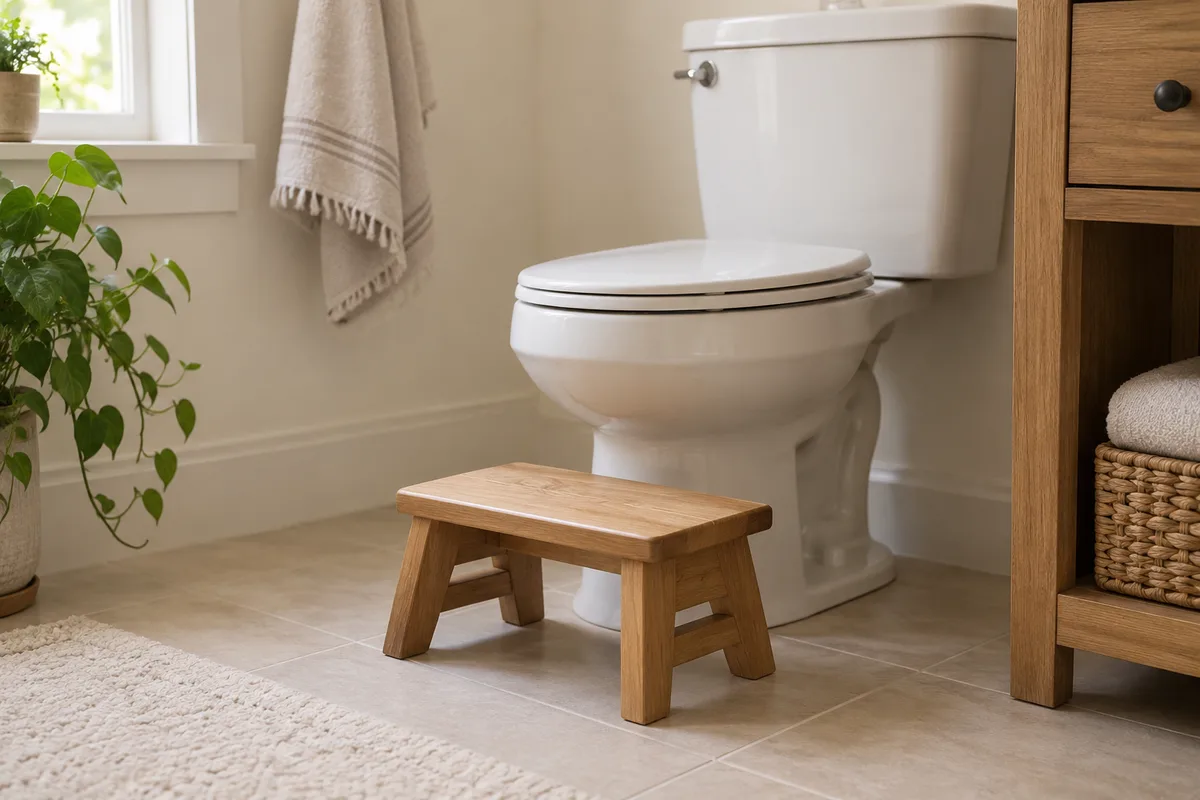
Some people find it easier to pass stool with their feet supported on a low footstool and their knees raised above their hips. The NHS suggests using a footstool and relaxing the muscles; a forward lean may also feel comfortable. Research on altered posture is limited and has mainly involved healthy volunteers, so results may not apply to everyone with constipation.
Posture fixes the exit angle — it helps most with straining and long toilet sessions. If the stool itself is hard, soften it first with food and fluids (what foods help with constipation). If the stool isn’t hard but never fully empties, that can be a pelvic-floor coordination issue where posture is only one baseline measure. Work out which case you’re in below.
What posture can fix
- Most direct help: the stool is right there but passing it takes effort and time, with repeated straining. Posture and breathing change how efficiently you push.
- Needs company: hard dry stool — posture eases the exit, but the hardness itself needs diet and hydration, covered in what foods help.
- Limited help: the stool isn’t hard yet never comes out or feels finished — that pattern suggests pelvic-floor dyssynergia, which needs professional evaluation. Posture is one of several baseline measures.
- Not applicable: urgent pain, vomiting, blood in the stool — go straight to when to see a doctor.
What modern medicine says
The rectum has a bend, and posture sets how sharp it is. The rectum and anal canal don’t form a straight pipe — the puborectalis muscle slings around the junction and pulls it forward, creating an angle. Standing and upright sitting keep that angle near 90 degrees, so stool has to “turn a corner” to exit. In a squat, deep hip flexion relaxes the sling, the angle opens, and the channel approaches a straight line. That’s the anatomical reason squatting takes less effort than sitting.
There’s data. A 2003 study of 28 healthy volunteers found lower self-reported straining and shorter emptying time when squatting than when sitting. A 2019 study followed 52 healthy volunteers using a posture-modifying device; participants reported less straining and shorter bowel-movement duration. These small studies in healthy volunteers do not establish how much a footstool helps people with constipation.
Straining itself has a cost. Breath-held pushing (the Valsalva maneuver) spikes abdominal pressure, and repeated heavy straining over years is tied to hemorrhoids and pelvic-floor stress. For someone constipated, “strain less” matters as much as “get it out” — which is exactly what posture adjustment delivers.
Timing completes the picture. Beyond posture, the NHS advises allowing enough time and responding when you feel the urge. Some people find it useful to try after breakfast, when eating can stimulate bowel activity; this timing does not work for everyone.
How Chinese medicine understands it
In the traditional Chinese medicine (TCM) framework, defecation is the final step of “the bowels’ qi descending,” and the tradition’s position on straining is emphatic: “do not force the push” — straining with held breath is said to spend qi and injure the body, Spleen- and Lung-qi in particular. Traditional wellness guidance on the toilet is “go at a regular time, let it happen naturally” — never “stay until it happens.” That stance matches the modern observation that repeated hard straining feeds hemorrhoids and pelvic-floor stress: defecation is at its core an act of release, not force.
The traditional frame holds one more idea that rhymes with posture: bowel movement is part of the whole body’s qi dynamics, and traditional practice emphasizes a calm, continuous breath rather than breath-holding. This is a traditional wellness view; it does not establish a modern physiological mechanism. This is a traditional empirical model, not an equivalent of modern physiology (for an overview, see NCCIH’s TCM page).
By constitution tendency:
- Qi-deficiency constitution tendencies: if passing stool is effortful and leaves you tired, avoid long squatting and forced pushing all the more — a well-set posture spends less of your already tight qi budget. If nothing comes, stand up and try again later.
- Yang-deficiency constitution tendencies: keep warm for early-morning bathroom visits — the waist and abdomen shouldn’t catch cold; heat a freezing bathroom first.
- Qi-stagnation constitution tendencies: no phone, no time pressure on the toilet — tension and rushing antagonize exactly the muscles that need to let go. Three slow breaths after sitting down.
The link runs one way: tendencies shift the emphasis, not that “straining to poop” proves qi-deficiency. Patterns mix and shift; formal differentiation takes an in-person TCM practitioner.
The correct toilet posture
Turning “stool, lean, breathe” into steps:
- Support your feet — a stable footstool can raise your knees above your hips. Around 20 cm is one possible starting height, provided your feet remain secure and the position feels comfortable.
- Lean forward, elbows on thighs or knees, lower back relaxed — this flexes the hips toward the squat’s angle.
- Breathing: breathe naturally and avoid holding your breath or straining hard. Stop if you feel pain or dizziness.
- Cap it at 5–10 minutes. No urge? Get up — sitting and waiting for inspiration is itself a hemorrhoid risk factor.
- Keep a fixed slot: within 15–45 minutes after breakfast, riding the gastrocolic reflex; and when the urge comes at other times, go — don’t postpone.
TCM methods
The five categories below pair with the posture change, each marked with the constitution tendencies it suits. Everything in the food section is a food-therapy use of culinary ingredients; if you intend to use them as medicinal herbs, consult a licensed TCM practitioner.
Acupressure and self-massage
Press before bathroom visits to bring the gut online. Fingertip pad, mild bearable ache:
- Zhigou (TE6): back of the forearm, four finger-widths above the wrist crease, between the two bones, 60 seconds per side. Traditionally the empirical constipation point — pressing it while seated on the toilet is the traditional use.
- Tianshu (ST25): about three finger-widths to either side of the navel, 60 seconds per side. Traditionally regulates Large Intestine conduction.
- Zusanli (ST36): about four finger-widths below the outer knee hollow, one finger-width out from the shinbone, 60 seconds per side. Traditionally supports the Spleen and Stomach — daily pressing builds baseline propulsion.
- Belly rub: every morning, palm strokes along the colon’s path (lower right → upper right → upper left → lower left) for 3–5 minutes; direction matters. Full technique in how to massage your stomach.
Cautions: pregnant women should not press abdominal points or do the belly rub; skip over unhealed abdominal surgery or hernias; stop if it hurts. Qi-deficiency leanings halve the pressure.
Food therapy
Posture smooths the exit; diet softens what exits.
Chinese home-style track (ingredients at Asian supermarkets or online):
- Honey water: 1 teaspoon honey in 250 ml warm water on waking. Traditionally moistens the intestine — for hard dry stool; not for blood-sugar management, never for infants under one.
- Walnut-sesame porridge: 15 g each walnuts and black sesame, ground, simmered with 30 g rice into a porridge, warm at breakfast — recipe in walnut-sesame porridge. Traditionally moistens intestinal dryness, suiting the dry kind; skip during diarrhea.
- Sweet potato and millet congee: 100 g sweet potato and 40 g millet simmered for 30 minutes. Traditionally supports the Spleen and widens the intestines — a gentle staple for yang- and qi-deficiency leanings.
Western everyday track:
- A skin-on pear or two kiwifruit after breakfast — the fruit plan slots straight into the after-breakfast bathroom window.
- Overnight oat cup: 50 g oats, 1 tablespoon chia seeds, 150 ml milk, refrigerated overnight. Soluble fiber plus water — so the posture’s “exit advantage” has something soft to work on.
Emotional care
Some people notice that stress makes bathroom visits harder. The traditional frame describes this as qi constraint; modern medicine separately examines whether the pelvic floor coordinates and relaxes during defecation. These are different explanatory frameworks and should not be treated as equivalent. If it feels comfortable, try three slow breaths after sitting down; if nothing happens, get up and try again later rather than straining.
Movement
Core strength contributes to the pressure a bowel movement needs: twice-weekly light core work — alternating supine leg raises, 10 each, and planks from 20 seconds up by 5 a week. Daily walking supports overall gut motility, best 10–15 minutes after meals — see exercises for constipation. Qi-deficiency leanings halve the core work; yin-deficiency leanings keep sweat light.
Sleep and daily rhythm
- Ring-fence the bathroom time in your schedule — fixed within 15–45 minutes after breakfast, not squeezed into a rushed morning; if mornings come with a phone, leave the phone out.
- Finish dinner 3 hours before bed and keep three regular meals — a stable gut rhythm is what makes the bathroom window reliable.
- Go as soon as the urge appears — a repeatedly overridden urge blunts over weeks, and rebuilding it takes just as long.
Toilet habit step card
Save this on your phone and follow it for two weeks:
- Within 15–45 minutes after breakfast, or whenever the urge comes, go promptly;
- Footstool set, knees above hips, lean forward, elbows on knees;
- Natural inhale, long slow exhale, no held-breath heaving;
- If nothing in 5–10 minutes, get up — no camping;
- No phone in the bathroom — attention itself is part of pelvic-floor release.
After two weeks, evaluate: is the session shorter? Is the straining lighter? If the stool’s still hard, work the diet side; if incomplete emptying persists, look into a pelvic-floor evaluation.
How long until you see improvement
- Posture itself: a footstool or forward lean may feel different right away, but the effect varies.
- Easier passage and shorter sessions: notice whether these change over time; there is no set timeline.
- Bowel rhythm: a regular routine may help over time; there is no fixed timeline.
Good posture, soft stool, and still can’t pass or feel finished for more than two weeks — that’s beyond what posture can fix. Pelvic-floor dyssynergia is a possibility, and it has an established treatment (biofeedback) through gastroenterology or a pelvic-floor clinic.
When to see a doctor
- Blood in the stool, unexplained weight loss, or persistent fatigue;
- Persistent or worsening abdominal pain, vomiting, fever, or inability to pass gas — prompt care;
- A sudden change in bowel habits, especially new after age 40;
- Persistent inability to pass soft stool or a lasting unfinished feeling — get the pelvic floor checked;
- Four to six weeks of posture plus diet adjustment with no improvement.
This article is general health education and can’t replace a doctor’s diagnosis or individualized advice.
Common questions
Is a squat toilet actually better than a seated one?
Anatomically, the squat does run straighter — but you don’t need to renovate. A footstool brings the seated posture close to the squat’s effect. And a deep squat isn’t suitable for everyone: older adults with knee or hip problems shouldn’t attempt it. A footstool may help some people; use one only if it feels comfortable and provides stable support.
How high should the stool be?
There is no single required height. Choose a sturdy support that feels stable and raises your knees comfortably; stop if the position causes pain or feels unsafe. No dedicated stool? A sturdy step or storage box works — stability first.
Can I read or scroll on the toilet?
Better not. Distraction stretches toilet time, and long sitting on the toilet is a hemorrhoid risk; defecation also needs conscious pelvic-floor release, which goes poorly with a split attention. Nothing in 5–10 minutes — get up.
For the massage companion, read how to massage your stomach; for how long without a movement deserves attention, how long is too long; the full framework is in the constipation hub.
Posture's right but it still won't come out? The problem may be elsewhere
Posture fixes the exit angle; hard stool or weak propulsion still needs diet and rhythm work. The free constitution test shows your tendencies from a traditional wellness perspective and helps point the overall direction. It's a self-observation tool, not a medical diagnosis.
References5 sources
- 01
Digestive Diseases and Sciences (PubMed / NIH)
- 02
Journal of Clinical Gastroenterology (PMC / NIH)
- 03
UK National Health Service (NHS)
- 04
U.S. National Institute of Diabetes and Digestive and Kidney Diseases (NIDDK / NIH)
- 05
U.S. National Center for Complementary and Integrative Health (NCCIH / NIH)
Personalized guidance
Use the app for constitution-friendly ideas and structured plans when available.
Download the App
Get personalized TCM health recommendations