I Feel Tired and Sad All the Time — What's Going On?
Feeling tired and sad all the time usually isn't one disease. Stress, poor sleep, and burnout drag energy and mood down together, but depression, thyroid problems, and anemia can hide behind the same feeling. Here's how to tell the difference, a two-week self-check, and what actually helps.
By WellTao · Published: · Last updated: · Editorial Policy
More articles in this topicTable of contents
The Short Version
If you’ve caught yourself thinking “I feel tired and sad all the time,” the two are usually two sides of the same coin. They feed each other, and most of the time they don’t mean you’re ill. Short-term stress, broken sleep, and months of running on overdraft can drain energy and mood at the same time — and that state typically lifts on its own within days to weeks once the pressure passes and sleep catches up. The NHS frames ordinary low mood the same way: it often eases within days or weeks and responds to small changes in daily life.
The line worth taking seriously has three parts: it has lasted more than two weeks, it’s there nearly every day, and it’s started to interfere with doing things and looking after yourself. If all three apply, book an evaluation with a doctor. An evaluation is not a diagnosis — it’s letting a professional look. The rest of this article turns that line into concrete things you can watch for.
One thing before anything else: if you’ve had thoughts of harming yourself, talk to someone now — don’t carry it alone. In the U.S., call or text 988 (the 988 Suicide & Crisis Lifeline, free, confidential, 24 hours). In the UK and Ireland, call 116 123 (Samaritans, free). These lines aren’t only for emergencies; feeling awful and wanting to talk is reason enough.
Which Kind of Tired-and-Sad Is Yours
If your honest summary is “I feel sad and tired all the time,” the same heaviness can sit on top of very different states. Start with this table and see which column sounds more like you:
| A tired kind of low | A low worth getting evaluated | |
|---|---|---|
| How long it’s lasted | Days to a week or two, with ups and downs | More than two weeks, nearly every day |
| Is there a reason | Usually yes: a deadline, bad sleep, recovering from illness | No obvious reason, or the reason passed and the low didn’t |
| Things you enjoy | Interest is still there, you just have no energy for them | Interest clearly gone; doing them brings no pleasure |
| After rest | A good night’s sleep or a weekend restores you | Rest doesn’t touch it |
| Effect on daily life | Slower, but still managing | Work, eating, socializing, and self-care are all getting hard |
The right-hand column isn’t there to scare you. It mirrors the criteria medicine uses to assess depression: the U.S. National Institute of Mental Health (NIMH) describes the threshold as symptoms present most of the day, nearly every day, for at least two weeks, including either a depressed mood or a loss of interest. Fatigue and low energy are on that symptom list themselves — which is why doctors look at “tired” and “low” together instead of separately.
To be clear: neither this table nor this article can diagnose anything. Their job is to help you choose between “adjust and observe for now” and “worth booking an appointment.” Landing in the right column only means it’s time to talk to a professional — it doesn’t mean you have a disease.
What Modern Medicine Says
Why do tiredness and mood travel together? Modern medicine can see several interlocking gears.
Sleep and mood are a two-way loop. Poor sleep directly weakens next-day energy and emotional resilience, while low mood and anxiety disrupt falling and staying asleep. Insomnia is a common sleep disorder in its own right; short-term insomnia is usually triggered by stress, shows up as trouble falling asleep, restless sleep, or poor sleep quality, and then drags down the daytime. Let the loop spin long enough and you can no longer tell whether the tiredness or the sadness came first.
Depression often arrives in physical form. Many people picture depression as “feeling sad inside,” but the NIMH’s list of common symptoms includes fatigue, low energy, slowed movement, changes in sleep and appetite, and unexplained aches and pains. A sizable share of people notice “why am I so exhausted lately” before they notice “my mood is off.” That’s exactly why tired-plus-low lasting more than two weeks deserves an evaluation rather than more pushing through.
Chronic stress and burnout. Under sustained pressure the body stays in fight-or-flight mode, and a stress system that never powers down burns through physical energy and emotional reserve at once. The full mechanism of stress and fatigue lives in our stress hub and fatigue hub; we won’t repeat it here.
Physical problems can masquerade as mood problems. The NIMH specifically warns that certain medical conditions — thyroid disorders, for example — can produce a picture nearly identical to depression, so doctors usually start an evaluation with a physical exam and lab work to rule those out. Iron deficiency and other nutritional problems are common causes of fatigue too. The order applies to everyone: rule out the body first, then talk about the mood.
Hormones and seasons. In women, the premenstrual days, the postpartum months, and perimenopause all involve hormone shifts that pull directly on mood and energy, and the NIMH lists these stages as specific windows of higher depression risk. Seasons matter as well: as autumn and winter shorten the daylight, some people develop a low state that comes and goes with the seasons (seasonal affective disorder), and light therapy has evidence behind it for that pattern.
Loneliness and inactivity. A long stretch without social connection leaves mood with no buffer, and exercise is one of the most thoroughly studied mood regulators there is. The first item on the NIMH’s self-care list for people with depression is that even a 30-minute daily walk can lift mood. Not because it cures anything, but because it loosens the “the less you move, the less you want to move” cycle.
How Chinese Medicine Understands It
In the Chinese medicine framework, emotion and fatigue were never two separate things. Traditional theory covers both with “qi,” the force that keeps the body running and that emotional activity depends on to flow freely. The Basic Questions (Suwen) of the roughly 2,000-year-old Yellow Emperor’s Inner Classic has a widely quoted summary — “all illness arises from qi” — meaning that emotions (anger, grief, worry, fear) directly change how qi moves: overthinking knots it up, and prolonged grief wears it down. In plain terms: when emotion is stuck, the flow of energy is stuck; when energy flows slowly, you’re easier to pull under by emotion. That’s the same “fatigue–low mood loop” modern medicine describes, in a different language. What follows is the traditional framework, offered for self-observation — an empirical model, not a diagnosis in the modern medical sense.
If you’ve been asking yourself, “Why am I so moody and tired lately?”, the tradition would look at which of three common patterns your state most resembles:
The pent-up kind (tiredness from stuck emotion): the tiredness has a base note of “stifled” — a chest that feels blocked, frequent sighing, fullness around the chest and ribs, a clear worsening after stressful events or friction with someone, and appetite and sleep that rise and fall with your mood. In the traditional frame, the Liver governs the free flow of emotion; when that flow jams, you end up both stifled and drained.
The worn-out kind (tiredness from running dry): the tiredness is a soft, continuous depletion — heavy thinking and worrying, unreliable memory, palpitations, a so-so appetite, a sallow complexion, and a mood that isn’t sharp sadness but a flat, can’t-get-it-up dullness. It’s common in people who have strained their minds for a long time, eat irregularly, or spend more energy caring for others than for themselves. Traditionally this reads as both ends running short: the Heart “housing the mind” and the Spleen “producing qi and blood.”
The mixed kind: emotional suppression arrives together with digestive and energy problems — sighing, bloating, and loose stools alternating with weakness and low spirits. This is one of the most common combinations in practice, and a reminder not to stuff yourself into a single label.
This tradition of watching “emotion and body falling out of tune together” is very old. About 1,800 years ago the Essential Prescriptions from the Golden Cabinet recorded a state called “zang zao” — “prone to sadness and the urge to cry, as if overtaken by a spirit” — describing exactly that unexplained sadness and tearfulness, and left behind the classic formula Ganmai Dazao Tang (licorice, wheat, and jujube). This is classical knowledge for context; any actual use of such a formula requires in-person evaluation by a licensed practitioner.
Traditional accounts also discuss tendencies using categories such as qi-stagnation constitution, qi-deficiency constitution, the nine TCM constitution types. These are classifications within the traditional framework, not validated predictions of symptoms or explanations of a medical cause. A few episodes, a clock time or a quiz result cannot establish a diagnosis. Persistent symptoms need medical assessment; any TCM pattern needs individual practitioner assessment. See the NCCIH overview for research and safety limits.
Everyday Adjustments
The guiding principle, written for people who wake up thinking “I feel so sad and tired all the time” and have no motivation to spare: shrink the first step until it’s impossible to fail. When your mood is low, advice like “exercise 30 minutes a day” is itself a stressor. Every item below starts at its smallest version.
- Exercise: start with a 5-minute walk out the door. Research supports about 30 minutes a day, but you don’t need to hit that number at the start — putting on shoes and walking downstairs for 5 minutes counts as done. Extend naturally as your state recovers, and walk in the afternoon or early evening if you can; you’ll catch some daylight on the way.
- Light: open the curtains first thing, or stand outside for 10 minutes. Morning light calibrates both your sleep rhythm and your mood rhythm, and it’s especially worth doing if autumn and winter clearly make things worse.
- Socializing: start with company that requires no talking. Don’t force yourself to open up. Sending a family member one message, sitting in a café with people around, walking alongside an acquaintance — all of it counts. In a low stretch, the dose of company matters more than the depth.
- Sleep: hold one anchor only — a fixed wake time. Ignore bedtime for now. Get up at the same time every day (within an hour on weekends); once the rhythm stabilizes, sleepiness will start arriving on its own at a steadier hour.
- Alcohol and caffeine: alcohol numbs feelings short-term, then deepens the low and the fatigue the next day. Keep caffeine away from the afternoon — none after about 2 p.m.
- Keep one small thing you finished each day. Making the bed or answering one email both count. When your mood is low, the felt sense of “I can still get things done” is the most practical evidence against helplessness.
TCM Methods
The five categories below stack. Start with the one or two easiest to keep up. For emotional problems, emotional care comes first; the other four are support.
Acupressure Points
Once a day, press with the pad of a finger, firm enough for a mild, bearable ache, 1–2 minutes per point, breathing slowly. If you’re pregnant, consult a practitioner before pressing.
Taichong (LR3) Location: on the top of the foot, between the big toe and the second toe, sliding up along the groove between the bones until you reach a depression. Traditional use: the most-used point for easing constrained Liver qi. Suits bottled-up emotion, frequent sighing, and irritability alternating with low spirits.
Neiguan (PC6) Location: on the inner forearm, about three finger-widths up from the wrist crease, between the two tendons. Traditional use: traditionally used to open the chest, move qi, and settle the mind. Suits a blocked feeling in the heart, chest tightness, and palpitations accompanied by low mood.
Shanzhong (CV17) Location: at the center of the chest, on the midline at the level between the nipples. Traditional use: known traditionally as the “meeting point of qi,” used for chest tightness and sighing from stalled qi. Press gently, or rub slowly up and down with the heel of your palm for 1–2 minutes.
All three points lean toward easing constraint and settling the chest, so they suit the pent-up pattern best. For the worn-out kind of tiredness (the qi-deficiency direction), acupressure plays a supporting role — put the main effort into sleep and meals.
Food Therapy
Chinese home-style track:
- Rose bud tea: 3–5 dried rosebuds (sold as rose tea at Asian grocers, tea shops, or online; look for food-grade rose) steeped in about 300 ml of hot water, sipped through the day. Traditionally used to ease constrained emotions, gentle enough for daily use. Amounts and details are on the rose flower tea page. Suits the pent-up direction.
- Aged tangerine peel and ginger water: about 3 g of chenpi (aged dried tangerine peel, sold at Asian supermarkets or online) simmered with 2 slices of fresh ginger. Suits the pent-up direction with bloating and a poor appetite.
- Jujube and millet congee: 2–3 jujubes (Chinese red dates, at Asian supermarkets or online) simmered with millet into a porridge. Millet settles the stomach and jujubes support the Spleen and nourish blood in the traditional frame; use it as an everyday staple for the worn-out direction. (These are food-therapy uses; for medicinal use, consult a TCM practitioner.)
- The Essential Prescriptions from the Golden Cabinet’s Ganmai Dazao Tang (licorice, wheat, jujube) is the classic formula for the “sad and wanting to cry” state — read it as knowledge only; actual use requires a practitioner’s in-person evaluation.
Western everyday track:
Same thinking, built from ingredients any American or British supermarket stocks:
- Honey-cinnamon oatmeal: 50 g rolled oats simmered 5 minutes in about 250 ml of water or milk, with a pinch of cinnamon and 1 teaspoon of honey; add half a sliced banana if you like. Warm oatmeal is gentle on the stomach and steadies blood sugar — the Western breakfast version of the jujube-millet congee idea. Suits the worn-out direction as a daily staple.
- Sweet potato, squash, and chicken soup: 1 chicken leg (or 150 g chicken breast) with 1 sweet potato (about 200 g), 200 g pumpkin or butternut squash, and 2 slices of ginger, simmered in about 800 ml of water for 30 minutes, lightly salted. Chicken is warm and nourishing, and sweet potato and squash are easy to digest — a proper meal for days when you’re too drained to have an appetite. Suits the worn-out direction.
- Dates and banana snack: 2–3 Medjool dates with half a banana, eaten in the mid-afternoon slump when mood and blood sugar dip together. Dates play the nourishing role jujubes do, and they’re a far steadier reach than dessert.
- Ginger and honey water: 2 slices of fresh ginger steeped in about 250 ml of hot water for 5 minutes, with 1 teaspoon of honey stirred in once it cools to warm. It answers the same move-qi-and-settle-the-stomach direction as the tangerine peel water; method details are on the ginger tea page. Suits the pent-up direction with bloating and poor appetite.
Rose tea, the tangerine peel water, and the ginger-honey water suit the pent-up direction; the jujube-millet congee, honey-cinnamon oatmeal, and sweet potato chicken soup suit the worn-out direction (the qi-deficiency and blood-deficiency leanings) as daily staples. Everything here is a food-therapy use of culinary-grade ingredients; if you intend to use any of them as medicinal herbs, consult a licensed TCM practitioner first.
Emotional Care
The most central category in this article. Traditional self-cultivation holds that the Liver keeps emotion flowing — and flow, not suppression, is the goal. “Just look on the bright side” never works, because it asks you to skip the feeling and jump straight to a conclusion. Emotional unblocking goes down a different road: first be seen, then be expressed, and only then can it loosen.
- Name the feeling. When you log your day, ask one more question: which is closer right now — hurt, emptiness, irritability, or numbness? A feeling you can name has already started to lose intensity.
- Give emotion an exit. Talking it out, writing it down, having a cry — all count. Crying isn’t weakness; in the traditional view, “grief wears qi down,” and it’s bottled-up sadness that truly drains you.
- Make no major decisions late at night. The night hours are when rumination runs heaviest and judgment runs worst. Write the nagging item on paper, with a note of what time tomorrow you’ll think it through.
- Don’t treat emotion as the enemy. A low mood is the body saying “spending has exceeded supply for a long time” — a signal, not a malfunction. Getting angry at the signal only costs more energy.
Emotional care is the first priority for the pent-up direction. It applies to the worn-out direction too, but don’t force yourself to “express” — sleep and eat first, and the strength for feelings comes back on its own.
Movement and Exercise
If ordinary activity causes delayed worsening lasting days, stop increasing exercise and seek assessment. Persistent unexplained fatigue or fatigue affecting daily life warrants an appointment now; a self-care trial is not a prerequisite. See the fatigue topic’s care guidance.
- Walking is always the first choice, at the pace and duration described in the previous section.
- Baduanjin (Eight Pieces of Brocade) and tai chi — slow, flowing sequences coordinated with breathing — suit people whose emotions feel stifled and whose bodies feel stiff. NCCIH’s overview notes some research support for tai chi improving mood. Ten to fifteen minutes each morning is enough.
- Chest-opening stretches: people in the pent-up pattern often hold their chests tight. Once an hour when you sit for long stretches, open the chest and roll the shoulders, releasing on the exhale.
Walking and gentle sequences suit both directions. If you lean pent-up, put extra attention on the chest-opening work; if you lean worn-out, treat “not tired afterward” as your ceiling and don’t chase duration.
Sleep and Daily Rhythm
- Fixed wake time, the same anchor as in every sleep article on this site; aim to be asleep by 11 p.m.
- Three meals at regular times. In a low stretch, appetite gets erratic, and blood sugar swings amplify mood swings directly — regular meals are the cheapest stabilizer there is.
- Dim the lights and put the phone down an hour before bed, letting the nervous system downshift.
This section is the foundation for both directions. People with a qi-deficiency tendency gain the most directly from regular meals; people in the pent-up direction especially need to hold the no-phone-before-bed line, because nighttime rumination is the most draining thing there is. If you run cold as well as depleted — the yang-deficiency leaning — the 11 p.m. bedtime and morning sunlight are the two to hold onto.
A Two-Week Mood and Energy Log
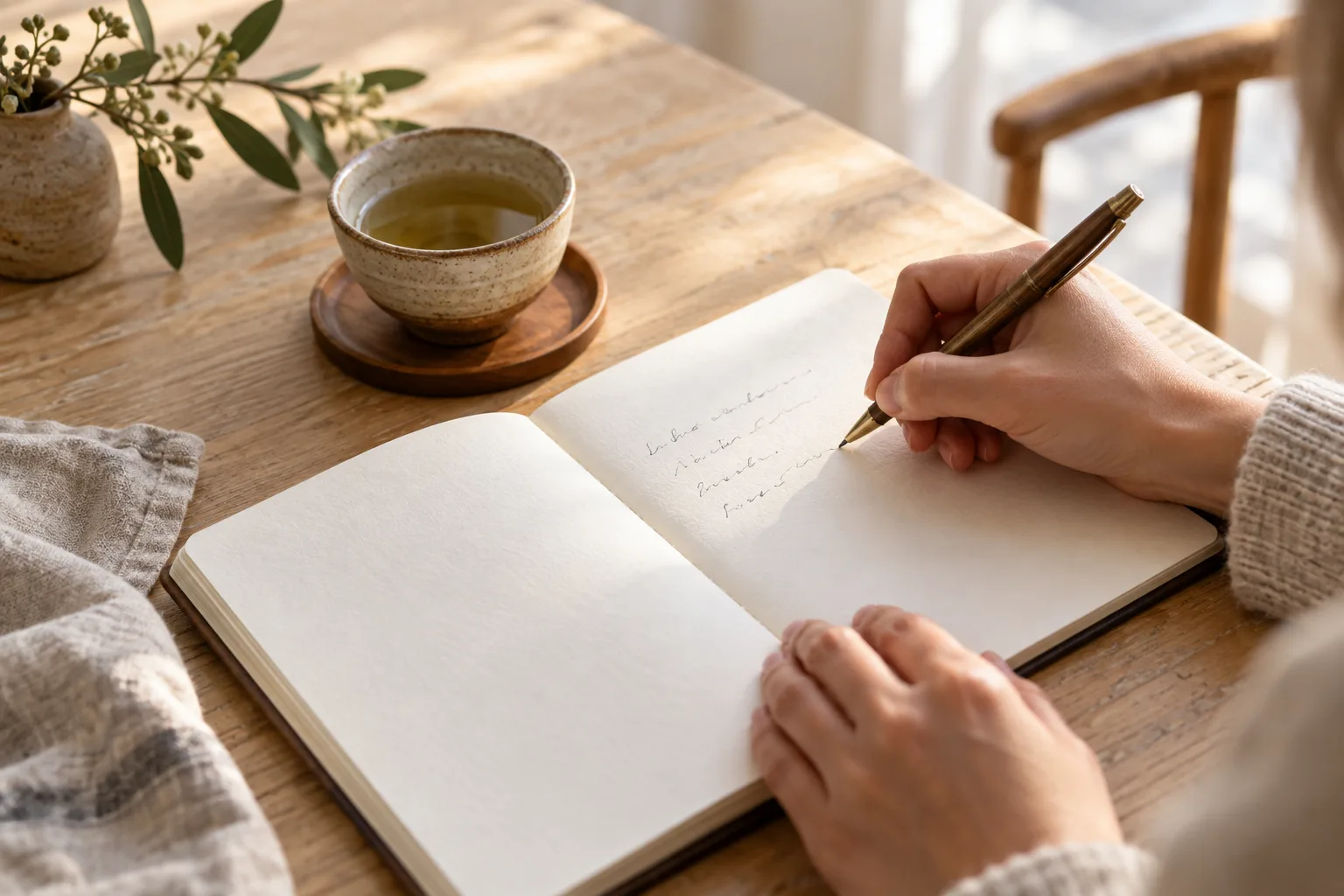
Two weeks — exactly the timeline medicine uses to separate an ordinary low from one worth evaluating. Spend one minute before bed each night recording five items:
| What to record | How to record it |
|---|---|
| Mood score | 0–10, where 0 is the worst and 10 the best |
| Energy score | 0–10, same scale |
| Sleep | Roughly how many hours, how many times you woke |
| Relevant events that day | Stress events, exercise, socializing, caffeine, alcohol |
| Impact | Did today’s state get in the way of doing things (no / somewhat / clearly) |
After two weeks, read it back and look at three things: whether the low mood scores appear nearly every day; whether interest and the ability to get things done stayed affected; and which events your mood rises and falls with. If low scores run through nearly the whole two weeks and the impact column often reads “clearly,” take this log to a doctor — it shows the trajectory of your state in a few minutes, far more accurately than recalling from memory. If the low scores cluster after stress events and move up and down, your emotions are still responding flexibly to what’s happening, and you can start with the adjustments in the next section while you keep logging.
This table is a self-observation tool, not a diagnostic scale. There’s no passing score; what matters is the trend.
How Long Until You See Improvement
Use the dates in your plan as review points, not promises of recovery. Responses to sleep, food and activity changes depend on the cause of fatigue and your circumstances. There is no established recovery timetable for the acupressure or food-therapy suggestions here.
- Review your notes weekly: compare sleep, daytime energy and the effects of activity. One better day does not identify a cause.
- Watch for delayed worsening: if ordinary activity brings a marked decline hours to a day or two later that lasts for days, reduce the load, stop increasing activity and seek assessment. Do not push through a fixed exercise plan.
- Arrange care when needed: unexplained fatigue lasting weeks or affecting daily life warrants a medical appointment. Do not wait to complete a diary or self-care trial; worsening symptoms or the warning signs below need earlier attention.
See NHS advice on fatigue and CDC guidance on post-exertional malaise.
When to See a Doctor
Seek help immediately, without waiting, if any of the following applies:
- Thoughts of harming yourself or of ending your life: in the U.S., call or text 988 (free, confidential, 24 hours); in the UK and Ireland, call 116 123 free (Samaritans). In an emergency, call your local emergency number (911 in the U.S., 999 in the UK).
Book an evaluation in the near future if any of these applies:
- Low mood or loss of interest lasting more than two weeks and present nearly every day — the shared assessment line of both NIMH and the NHS;
- Your state is affecting function: work or school is a struggle, you’re avoiding people, eating and sleeping have fallen apart, or you can’t look after yourself;
- The tiredness and low mood have no clear cause, or they persist after the stressful event has passed — thyroid problems, anemia, and other physical causes need ruling out;
- Weeks of your own adjustments have brought no improvement, or you’re only getting through on alcohol.
Seeing a doctor doesn’t mean “you’re sick.” The default first moves of an evaluation are to rule out physical causes and then assess your emotional state — and many people find a treatable cause at step one.
This article is general health education and self-observation reference; it can’t replace a doctor’s diagnosis or individualized advice. If you’re currently receiving mental health treatment or taking related medication, consult your doctor before changing anything, and never stop a medication on your own.
For the bigger picture of how emotion and fatigue interact, start at the stress hub and the fatigue hub; the “tired” side gets a fuller untangling in why you’re always tired and have no energy; and if the low stretch comes with lying awake at night, read why you’re tired but can’t fall asleep. To learn the body-type classification language first, read the nine TCM constitution types and the qi-stagnation constitution in detail, then take the free constitution test below.
Tired plus low mood still comes in different body-type directions
Feeling drained and weighed down by bottled-up stress calls for different first steps than the same feeling from running on empty. The free constitution test shows your tendencies across nine traditional body types and helps you pick a starting point. It's a self-observation tool, not a medical diagnosis.
References10 sources
- 01
U.S. National Institute of Mental Health (NIMH / NIH)
- 02
UK National Health Service (NHS)
- 03
U.S. National Institutes of Health, MedlinePlus
- 04
988 Suicide & Crisis Lifeline (U.S.)
- 05
Samaritans (UK and Ireland)
- 06
U.S. National Heart, Lung, and Blood Institute (NHLBI / NIH)
- 07
U.S. National Center for Complementary and Integrative Health (NCCIH / NIH)
- 08
U.S. National Center for Complementary and Integrative Health (NCCIH / NIH)
- 09Huangdi Neijing: Suwen (The Yellow Emperor's Inner Classic: Basic Questions)
Classic of Chinese medicine, ~2nd century BCE
- 10Jin Gui Yao Lue (Essential Prescriptions from the Golden Cabinet)
Classic of Chinese medicine, Zhang Zhongjing, ~3rd century CE
Personalized guidance
Use the app for constitution-friendly ideas and structured plans when available.
Download the App
Get personalized TCM health recommendations