Pressure Points for Headaches: Where to Press, How Hard, and Who Shouldn't
Headache pressure points, gentle pressing methods, evidence limits and precautions. Learn when self-care is reasonable and which symptoms need medical assessment.
By WellTao · Published: · Last updated: · Editorial Policy
More articles in this topicTable of contents
The Short Version
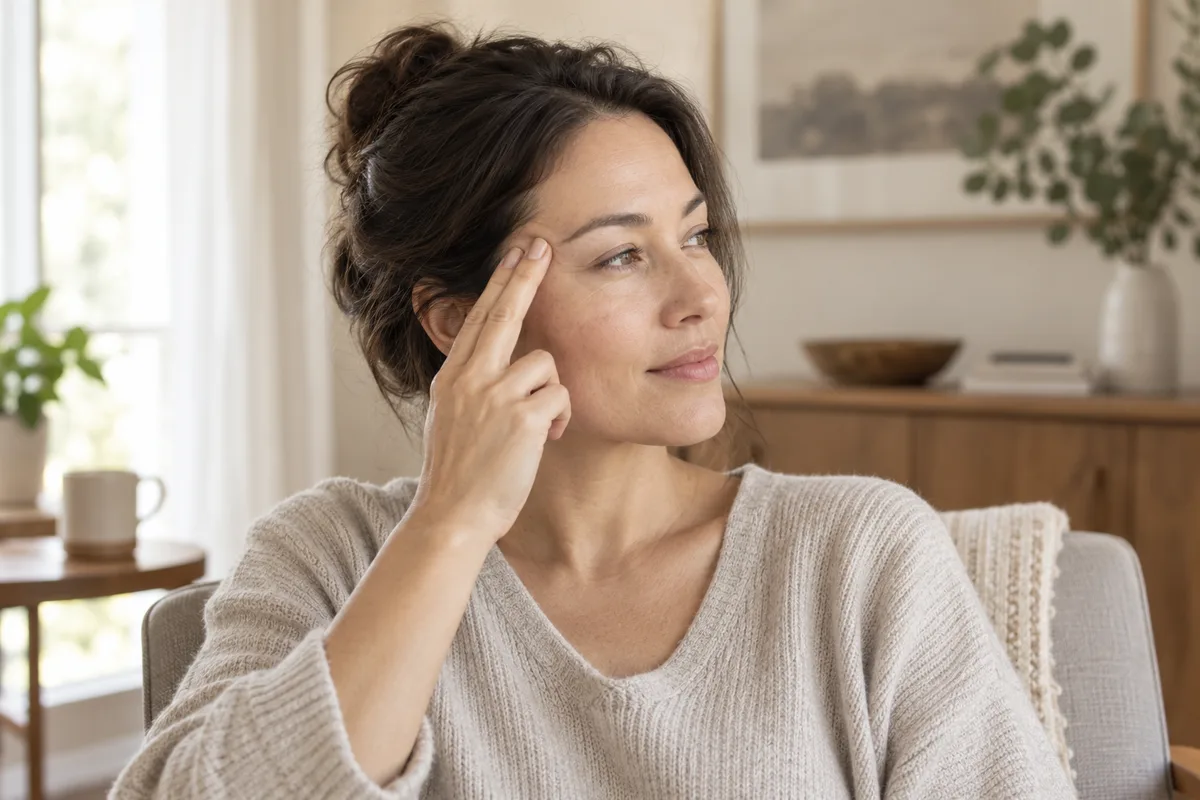
When a headache hits, these are the pressure points for headaches worth trying first: Hegu (LI4) on the hand, Taiyang and Yintang on the face, Fengchi (GB20) at the base of the skull, and Taichong (LR3) on the foot. Press with the pad of a finger in small circles, 30–60 seconds per point, firm enough to feel a mild, bearable ache, on both sides. One full round takes 5–10 minutes. Pressing needs no tools and costs nothing, which makes it a reasonable first move for occasional, mild-to-moderate headaches you know well: the tight-band squeeze of a tension-type headache, or the one-sided throbbing, light-and-noise-sensitive pain of a migraine.
Two boundaries come first. One: the research evidence for pressing is limited. Most acupoint studies for headaches used acupuncture needles, and needle results can’t be read as proof that pressing with your fingers works the same way. Pressing sits in the complementary relief category and doesn’t replace medication or medical care. Two: some people and some spots are off-limits. Do not press Hegu (LI4) or Sanyinjiao (SP6) during pregnancy (a traditional contraindication), and never press skin that’s broken, red, or swollen.
And some headaches don’t belong in the “press and see” category at all: a sudden severe headache that peaks within moments, a headache with high fever, stiff neck, trouble speaking, or one-sided weakness, or any headache after a head injury. Those go straight to a doctor. The full list is in the red-flag section.
Which Kind of Headache Do You Have
Whether pressing is worth trying first depends on which kind of pain you have:
- Tight-band, pressing ache (tension-type direction): both sides of the head, the face, or the neck feels squeezed or pressed, and the spot may be tender to touch. Ordinary activity is still possible, the pain lasts at least 30 minutes, and it can drag on for days. This is the most common kind of headache, typically set off by stress, poor sleep, and caffeine, and it’s the kind where pressing is most worth trying.
- One-sided throbbing (migraine direction): pulsing pain on one side that gets worse with movement, with sensitivity to light and sound and often nausea. An attack lasts anywhere from 4 hours to 3 days. Pressing can assist during an attack, but migraine has its own diagnostic and treatment path; if attacks are frequent, don’t rely on pressing alone.
- Blocked, sinus-type pressure: a stuffy, swollen feeling across the forehead and cheeks with a blocked or runny nose, usually during a cold or a bout of rhinitis. This kind benefits from adding the facial points.
- Neck-and-shoulder-driven pain: the ache spreads from the neck and shoulders up into the head, gets worse after long stretches of sitting with your head down, and you can find clear tender spots when you press the neck and shoulders or turn your head.
The rule of thumb is simple: occasional, mild-to-moderate headaches that feel the same each time are fine to self-manage. A headache that’s new, that has clearly changed in character, or that’s coming more and more often gets a medical evaluation first, and pressing second.
What Modern Medicine Says
First the headache itself, then why pressing might help.
Tension-type headaches come directly from sustained tightness in the muscles of the shoulders, neck, scalp, and jaw; stress, anxiety, too little sleep, and skipped meals all make one more likely. Migraine involves changes in the brain’s nerves and blood vessels, runs in families, and is commonly triggered by the menstrual cycle, stress and fatigue, irregular eating, and too much caffeine. The two kinds share obvious ground: muscle tension, stress rhythms, and lifestyle all play a role, and that’s exactly where pressing and relaxation can act.
Why might pressing help? The most direct explanation is muscular: pressing and massage can release chronically tightened neck, shoulder, and scalp muscles, and that tightness is the source of tension-type pain. The U.S. National Center for Complementary and Integrative Health (NCCIH) rates the massage research this way: two small studies suggest massage might help with migraine, but the evidence isn’t strong enough for firm conclusions.
NCCIH summaries describe evidence that practitioner-delivered needle acupuncture may help prevent some headaches. Differences from sham acupuncture are sometimes small, and the mechanisms remain uncertain. This research concerns needling, not finger pressure. Self-acupressure has more limited evidence; use gentle pressure only as an optional comfort measure and stop if symptoms worsen.
If you need headache painkillers more than two days a week, discuss your acute treatment and prevention plan with a doctor or pharmacist. Frequent use can contribute to medication-overuse headache. Acupressure may be tried as an optional comfort measure, but do not use it as a reason to delay prescribed treatment or change medication on your own. NHS migraine guidance.
How Chinese Medicine Understands It
Chinese medicine reads a headache as a problem with how qi and blood move through the channels of the head: either the flow is blocked (“where there’s no free flow, there’s pain”) or the supply is short (“where there’s no nourishment, there’s pain”). What follows is the traditional framework, offered for self-observation. It’s an empirical model, not a diagnosis in the modern medical sense.
A quick glossary for anyone new to this: “qi” is the body’s functional energy in traditional thinking, the thing that’s supposed to circulate and keep everything supplied. The “channels” (often translated as meridians) are a map of qi-and-blood pathways that practitioners drew over millennia of pressing and needling practice: which points connect to the head along which route is an empirical correspondence, worked out by hand. The Suwen, part of the roughly 2,000-year-old Yellow Emperor’s Inner Classic, opens its chapter on pain by saying “all illness arises from qi,” meaning emotional strain and overwork feed into pain by disrupting qi’s movement. A classical acupuncture verse adds “for the face and mouth, Hegu delivers,” making Hegu the traditional first choice for head and face problems, and that’s why headache pressing starts there.
Along this main line, headaches show up in three common patterns:
Distending, throbbing type: a swollen, throbbing ache at both sides or the temples, clearly worse after bottled-up anger, frustration, or high-pressure days, often with irritability, sighing, and a tight neck and shoulders. This reads as “qi getting stuck,” and it tracks with emotional swings.
Fixed, stabbing type: stabbing or dull pain in one fixed spot, tender when pressed, long-lasting, often heavier at night. Traditionally this points in the “blood not moving well” direction.
Heavy, foggy type: the head feels wrapped in a wet towel, dull and muzzy, with chest stuffiness, nausea, and a heavy body, worse on damp, rainy days. Traditionally this is read as “phlegm-dampness clouding the head.”
The traditional constitution framework uses categories such as qi-stagnation constitution, blood-stasis constitution, phlegm-dampness constitution, the nine TCM constitution types to describe everyday tendencies. Linking the patterns above to these categories explains that framework; it does not establish a medical cause, predict symptoms or select treatment. Experiences overlap and can change with sleep, diet, illness and medication. A qualified practitioner needs to assess any TCM pattern individually. The NCCIH overview of TCM explains research and safety limits; a constitution self-check cannot replace medical assessment.
One honesty note on the evidence: NCCIH’s overall assessment of Chinese medicine is that acupuncture has been studied relatively well for pain, while research quality in many other areas, including herbal medicine, is too uneven for firm conclusions. So read the TCM content here as a self-observation and daily-care framework, not a substitute for evaluation and treatment.
Everyday Adjustments
Pressing deals with the headache that’s happening right now; these adjustments deal with keeping it from coming so often:
- Steady sleep: go to bed and get up at roughly the same times every day, with no more than an hour’s drift on weekends. Sleep trouble is a common cause of tension-type headache, and migraine does best on stable, sufficient sleep too.
- Regular meals, no skipping: missing meals is a well-established migraine trigger. However busy you are, eat something.
- Cut caffeine down gradually: caffeine can trigger headaches, and quitting it cold turkey causes them too. Taper off, and keep none after 2 p.m.
- Drink enough water: dehydration is a headache trigger on its own. Pale-yellow urine is the simple gauge.
- Get up and move 2–3 minutes every hour: for neck-and-shoulder-driven headaches, this one habit removes most of the fuel. Add a neck stretch: tilt your head slowly to one side, rest the same-side hand lightly on your head, hold 20–30 seconds, do both sides, 2–3 sets a day.
- A low, firm pillow: if neck pain travels with your headaches, switch to a lower, firmer pillow. During an attack, a warm or cold pack on the neck and shoulders for 15–20 minutes helps.
- Scheduled downtime every day: the NHS specifically advises people with tension-type headaches to do relaxing activities such as exercise, yoga, or massage.
TCM Methods
The five categories below answer to the three patterns above. Pressing and daily rhythm are the base everyone can build on; pick the rest according to your pattern.
Pressure Points and Self-Massage
General rules: wash your hands, sit comfortably, and take a few slow breaths first. Use the pad of your thumb or index finger to press the point with small circles or steady pressure, firm enough to feel a mild, bearable soreness. Harder is not better; pressing to the point of real pain only tightens the muscles you’re trying to relax. Spend 30–60 seconds on each point, alternate left and right, choose 3–4 points per session, and keep the whole session to 5–10 minutes. Press during an attack, or once or twice a day as maintenance.
Hegu (LI4), the hand point Location: on the back of the hand, in the web between thumb and index finger, at the highest point of the muscle when you squeeze them together — the midpoint of the second metacarpal bone (the one running to the index finger), on its thumb side. Traditional use: “for the face and mouth, Hegu delivers.” The most-used point for head and face discomfort, and a reasonable first press for any kind of headache. 30–60 seconds per side. Do not use during pregnancy.
Taiyang, the temple point Location: in the hollow about one finger-width behind the midpoint between the outer tip of the eyebrow and the outer corner of the eye. Traditional use: the local point for throbbing temples and migraine attacks. Rub gently with a fingertip for 30–60 seconds, keeping the pressure light.
Yintang and Yingxiang, the sinus points Location: Yintang sits exactly between the eyebrows; Yingxiang sits in the nasolabial groove beside the midpoint of each nostril’s outer edge. Traditional use: for the blocked, sinus-type headache, add these two facial points, 30 seconds each.
Fengchi (GB20), the base-of-skull point Location: at the hairline on the back of the head, in the hollows on the outer sides of the two large neck muscles, roughly level with the earlobes. Traditional use: the key point for neck-and-shoulder-driven headaches. Use gentle surface pressure for 30–60 seconds; do not push deeply or manipulate the neck.
Taichong (LR3), the foot point Location: on the top of the foot, in the hollow where you can push no further along the groove between the big toe and second toe (just in front of where the first and second metatarsal bones meet). Traditional use: a common choice for emotionally triggered, distending, throbbing headaches; traditionally it soothes the Liver and moves qi. 30–60 seconds per side.
Sanyinjiao (SP6) Location: four finger-widths above the tip of the inner ankle bone, just behind the inner edge of the shinbone. Traditional use: often added for headaches that worsen around the menstrual period. Do not use during pregnancy.
Ear points Rub the whole outer ear gently between your fingers for 1–2 minutes, until it feels slightly warm. Ear acupressure has shown some positive results in chronic-pain research, but headache-specific evidence is lacking, so treat this one as plain relaxation.
This set of points mostly works by getting things moving, which suits the qi-stagnation and blood-stasis tendencies best. People with a phlegm-dampness tendency and the heavy, foggy pattern should add Yintang and Yingxiang. If you’re generally frail or prone to dizziness, press more lightly and stay seated. Skip any skin that’s broken, red, or rashy, and stop if pressing makes the pain worse.
Food Therapy
Chinese home-style track:
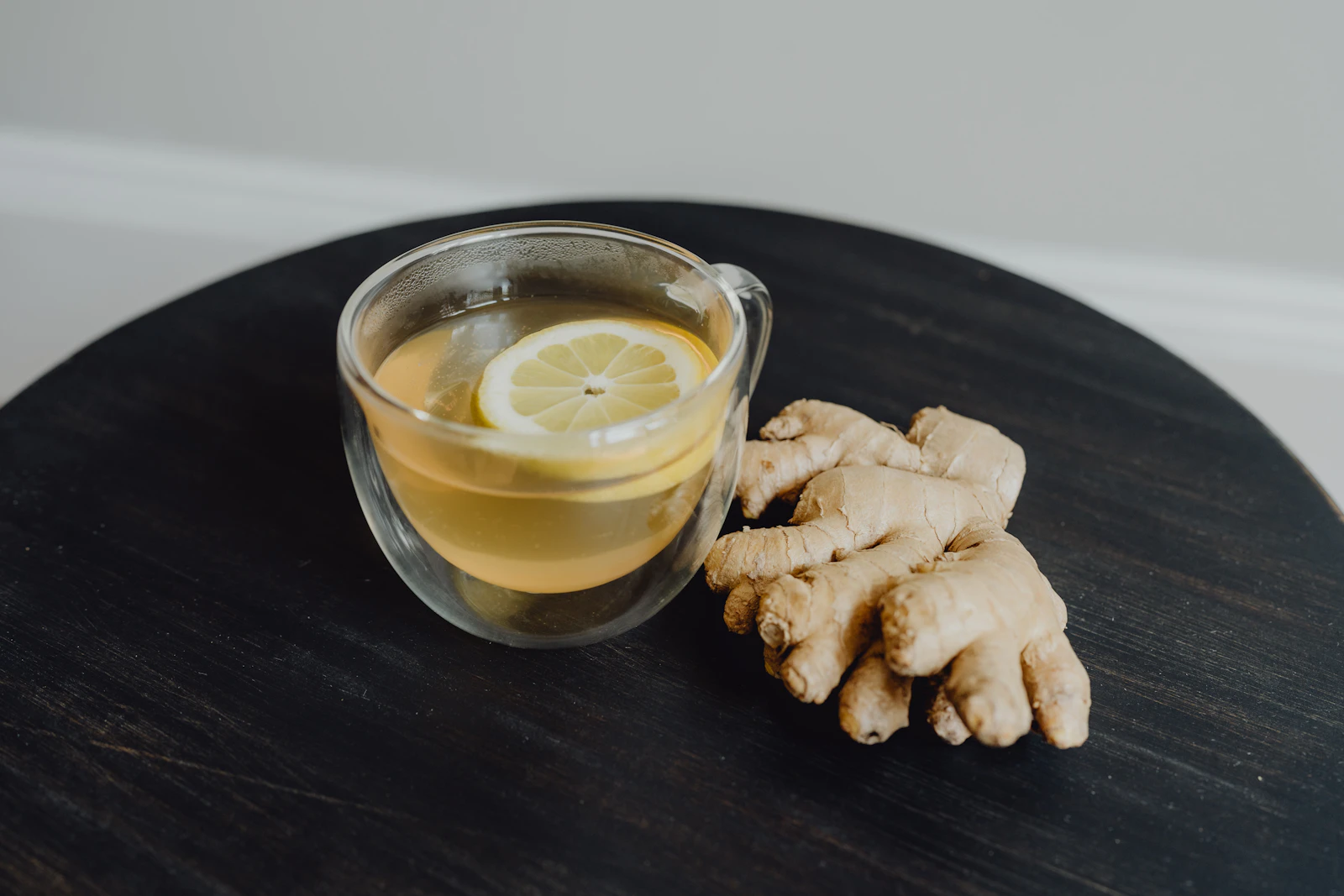
- Chrysanthemum and goji berry tea: 3–5 dried chrysanthemum flowers (the pale “Hangzhou white” type, sold as chrysanthemum tea in Asian supermarkets or online) plus about 10 goji berries (small dried red berries, also labeled wolfberries, found in the same places). Steep in freshly boiled water and sip as tea. Traditionally chrysanthemum clears and refreshes the head and eyes; this suits the distending, irritable type.
- Mint tea: 2 g of dried mint or a few fresh mint leaves steeped in hot water. Traditionally it eases constrained qi and refreshes the head, suiting the tight, stuffy type. Both forms are easy to find at Asian grocers, and dried mint online.
- Job’s tears and adzuki bean congee: 30 g Job’s tears (also called Chinese pearl barley, sold as yi yi ren at Asian supermarkets or online) and 30 g adzuki beans (small red beans), soaked 2 hours ahead, then simmered into a thin porridge for breakfast. Traditionally it supports digestion and drains dampness, suiting the heavy, foggy type.
- Cut back on sweets, fried and greasy food, and iced drinks: this kind of eating feeds the “dampness” direction behind a heavy head. If you’re the heavy, foggy type, run this change for a week and watch what shifts.
Western everyday track:
- Chamomile tea with honey: 1 chamomile tea bag steeped in hot water for 5 minutes, with 1 teaspoon of honey stirred in. For the distending, irritable type and for pre-sleep tension. Chamomile is a standard herbal-tea-shelf item in American and British supermarkets, and it works the same “refresh the head, settle the mood” direction as the Chinese teas.
- Peppermint tea: 1 peppermint tea bag steeped 3–5 minutes, sipped for the tight, pressure-band feeling or post-meal fogginess. Same direction as the Chinese-track mint.
- Pumpkin oatmeal: 50 g rolled oats and 100 g pumpkin cut into small cubes, simmered together in about 400 ml of water for 15 minutes, eaten as breakfast. Warm, soft, and easy to digest, it gives your system nothing extra to fight — the Western counterpart to the Job’s tears congee and its dampness-draining direction, suited to the heavy, foggy type.
- Steamed sweet potato with clear chicken soup: 1 sweet potato (about 200 g) steamed until soft, alongside a bowl of clear chicken soup (100 g chicken simmered 40 minutes in water with 2 slices of ginger), as lunch. Light, gently warming, low in oil and sugar: the same “don’t clog the machinery” direction the heavy, foggy type needs.
Both tracks serve the same two directions: the distending, irritable type takes the teas, and the heavy, foggy type takes the porridge and soup, while sweets, grease, and iced drinks come down in both. People with a phlegm-dampness tendency should lead with the porridge-and-soup items, and those with a qi-stagnation tendency with the teas. If you run cold or cold drinks bother your stomach, let the tea cool to warm before drinking. Everything here is a food-therapy use of culinary-grade ingredients; if you intend to use any of them as medicinal herbs, consult a licensed TCM practitioner first.
Emotional Care
Stress and emotion are shared triggers of tension-type headache and migraine, and if you have the distending, throbbing type, treat this section as your main line of work:
- During an attack, breathe first, press second: inhale slowly for 4 seconds, exhale for 6, for 5 minutes straight. Letting the neck and shoulder muscles loosen first makes the pressing work better.
- Give emotion a daytime outlet: a walk, a conversation, writing it down, anything that moves it out. People who sigh a lot need this most; sighing is the body trying to unclog itself.
- Headache after bottled-up anger: press Taichong and Hegu first, then deal with the problem.
Movement and Exercise
- Regular brisk walking: 30 minutes, 5 times a week, enough to break a light sweat. Regular exercise is one of the migraine self-management measures the NHS recommends.
- Baduanjin or tai chi: slow-paced, and a good starting point if your fitness is low. One small randomized study suggests tai chi may improve tension-type headache, but the sample was too small for conclusions; treat it as gentle exercise, not therapy.
- No exercise during a migraine attack: rest quietly, and lie down in a dark room for a while (also the NHS’s advice).
Sleep and Daily Rhythm
- Fixed wake time, in bed before 11 p.m.: sleep rhythm is the shared foundation for both headache types.
- Cap naps at 30 minutes, so daytime sleep doesn’t scramble the night.
- For women whose headaches track the menstrual cycle: start easing off caffeine and late nights a week before the period, and move the pressing forward to the “not hurting yet” stage.
Different constitution tendencies call for different emphasis, and that’s by design: qi-stagnation works on emotional release first, phlegm-dampness on diet first, and a blood-stasis tendency does best with pressing plus gentle exercise kept up over time. If you’d like to know which way you lean, the free constitution test at the end of this page is a self-observation tool (not a diagnosis): it shows your tendencies across the nine types and helps you decide what to do first.
A Step Card for Headache Acupressure
When a headache hits, run this card. About 10 minutes total:
- Stop and sit down: put the phone away, lean back in the chair, and breathe slowly for 1 minute (in for 4 seconds, out for 6).
- Pick points by the pain: distending or throbbing pain takes Hegu and Taichong; a tight-band ache takes Taiyang and Fengchi; blocked, sinus-type pressure adds Yintang and Yingxiang; neck-and-shoulder-driven pain adds Fengchi.
- Press one by one: 30–60 seconds per point, alternating sides, mild soreness as the pressure ceiling, 5–10 minutes per round.
- Score it: rate the pain 0–10 (10 is worst) before pressing and again right after.
- Re-check: note the score after 15–30 minutes. A change describes how you felt, not proof that pressing caused it. Stop if pain worsens, and use the care guidance rather than continuing a test.
Alongside the card, keep a simple headache log, one line per attack:
| What to record | How to record it | Example |
|---|---|---|
| Time and trigger | When it started, what you were doing before | 3:00 p.m., three straight hours of meetings |
| Quality and location | Distending / tight-band / throbbing / foggy, and where | Tight-band on both sides, mostly temples |
| Points pressed | Point names | Hegu, Taiyang, Fengchi |
| Before and after scores | 0–10 | 6 → 3 |
| After 30 minutes | Better / same / worse | Better |
| Any medication | Name and time | None |
Log for 2–4 weeks and your trigger patterns, plus which points actually work for you, will surface on their own. Bring the log to appointments; it’s exactly the headache diary a doctor would ask you to keep, and far more useful than describing attacks from memory.
How Long Until You See Improvement
Treat review dates as opportunities to assess symptoms, not guarantees of relief. Headache courses differ, and self-pressure, tea, posture or routine changes do not share an established timetable for benefit.
- During an attack: note whether rest or optional gentle pressure makes you more comfortable. Stop if it does not help, worsens symptoms or hurts; do not delay your agreed treatment to finish a routine.
- Review your diary weekly: summarize headache days, severity, associated symptoms and medicine days. The record helps a clinical conversation; it cannot establish a cause.
- Get assessed when needed: first exertional headache, pain worsened lying down, or new, changing or persistent headache warrants assessment rather than a mandatory one- or two-week trial. Discuss frequent acute-medicine use with a clinician; they decide any medication change. The emergency signs below need immediate help.
See MedlinePlus advice on seeking care.
When to See a Doctor
Pressing and self-care suit occasional, mild-to-moderate headaches you know well. Get medical care first if any of the following apply:
Emergency (call emergency services now):
- A sudden, severe headache that peaks within moments (“the worst headache of my life”);
- Headache with high fever, a stiff neck, or a rash, or with drowsiness and confusion;
- Trouble speaking, memory confusion, vision loss, or weakness or numbness on one side of the body;
- A headache that follows a head injury.
Urgent (same day or within days):
- A migraine attack lasting more than 72 hours without relief;
- Aura symptoms (flashing lights, zigzag lines, numbness) lasting more than an hour;
- A headache during pregnancy or after giving birth;
- Severe headache with jaw pain when chewing, blurred vision, or a tender scalp.
Book an evaluation:
- Attacks several times a week, or becoming more frequent or more severe;
- Painkillers and relaxation methods no longer helping;
- Using painkillers more than two days a week (medication-overuse headache needs ruling out);
- Repeated one-sided throbbing with light and noise sensitivity and nausea (migraine needs confirming and a plan).
This article is general health education and can’t replace a doctor’s diagnosis or individualized advice. If you’re pregnant, breastfeeding, or managing a chronic condition, talk to your doctor before trying any self-care method here.
Common Questions
Can pregnant women press any points for a headache?
During pregnancy, discuss headache and any acupressure with your maternity clinician first. Traditional practice cautions against stimulating Hegu and Sanyinjiao, but this does not establish the safety of other points. New or changing headache in pregnancy needs medical assessment.
Can acupressure cure headaches?
Acupressure is not an established cure. It may be an optional comfort measure, but recurrent headaches need assessment and an appropriate treatment plan. Do not change or delay medication because you are trying it.
Pressing is a method you can start today, but headache care is bigger than pressing. For the full picture of headache types and the care framework, start at the headache hub; if you get migraines, continue with pressure points to use during a migraine attack; if a tension headache just won’t leave, read what to do about a tension headache that won’t go away; and to work out your constitution tendency, read the nine TCM constitution types first, then take the free constitution test below.
Same headache, different results from pressing — which way does your body lean?
A distending, throbbing ache and a heavy, foggy head point to different constitutional tendencies, so which points to start with and which daily habits to pair them with differ too. The free constitution test shows your tendencies across nine traditional body types and helps you decide where to begin. It's a self-observation tool, not a medical diagnosis.
References6 sources
- 01
UK National Health Service (NHS)
- 02
UK National Health Service (NHS)
- 03
U.S. National Center for Complementary and Integrative Health (NCCIH / NIH)
- 04
U.S. National Center for Complementary and Integrative Health (NCCIH / NIH)
- 05
U.S. National Center for Complementary and Integrative Health (NCCIH / NIH)
- 06Huangdi Neijing: Suwen (The Yellow Emperor's Inner Classic: Basic Questions)
Classic of Chinese medicine, ~2nd century BCE
Personalized guidance
Use the app for constitution-friendly ideas and structured plans when available.
Download the App
Get personalized TCM health recommendations