Pressure Points for Period Cramps: Where and How to Press
Find SP6, LI4, ST36, and PC6; learn gentle pressure, timing, pregnancy cautions, and what the Cochrane evidence actually covers. Includes an 8–10-minute routine.
By WellTao · Published: · Editorial Policy
More articles in this topicTable of contents
The short answer
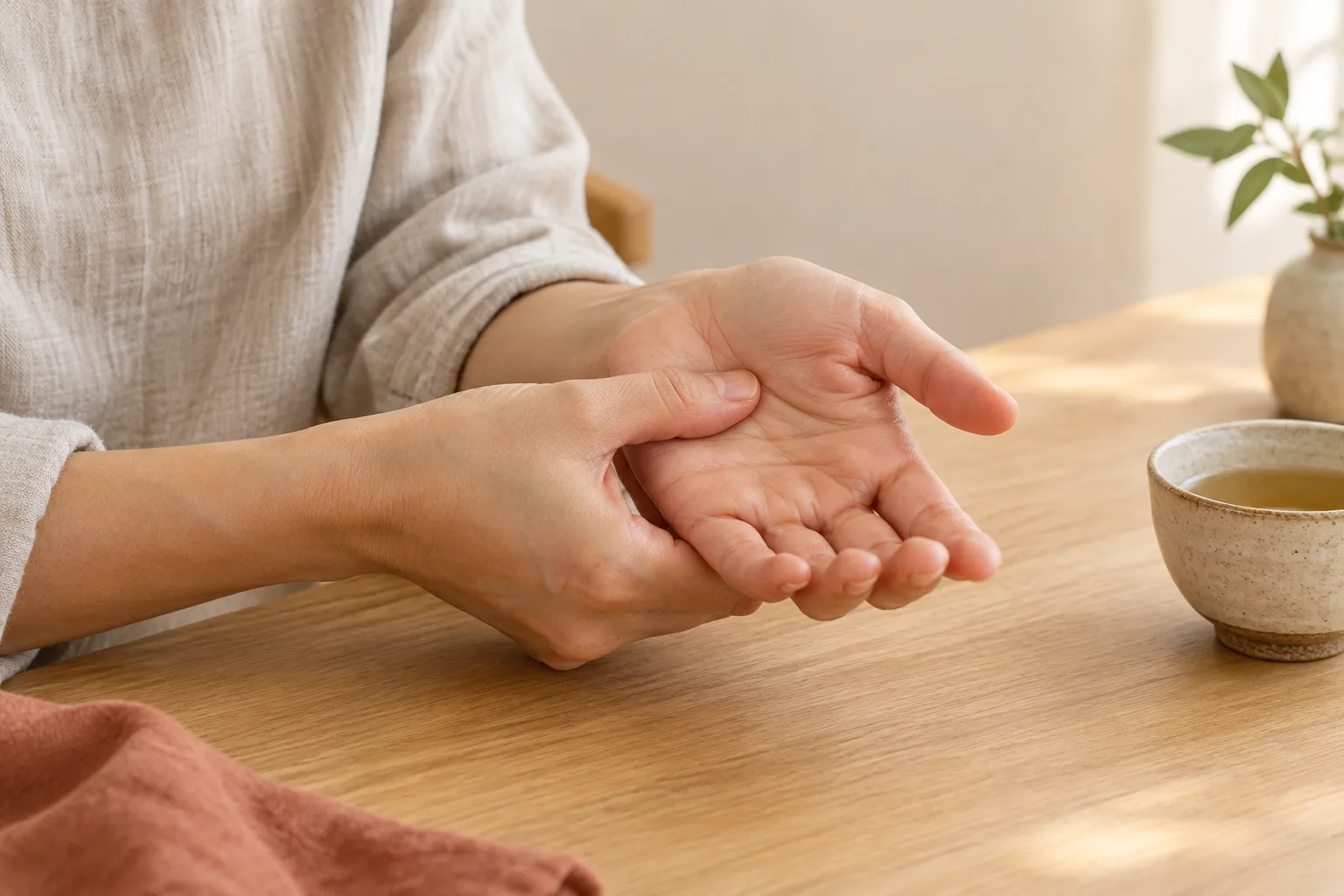
Four points are commonly used for self-applied pressure during period cramps: SP6 (Sanyinjiao), LI4 (Hegu), ST36 (Zusanli), and PC6 (Neiguan). Sit or recline, relax your muscles, then rub each point with a fingertip until it feels mildly sore or full, never sharply painful. Press 60 seconds per point on each side, once or twice daily, starting two or three days before a period and continuing during it. The exact locations and daily card are below.
The Cochrane review included both acupuncture and acupressure. They may help, but overall evidence is low quality, and most procedures were done by trained people. Their outcomes cannot directly prove that rubbing a point yourself for 60 seconds has the same effect. Acupressure is a low-cost, non-invasive addition to self-care rather than a replacement for pain medicine. Do not use SP6 or LI4 if pregnant or pregnancy is possible; traditionally these points may stimulate uterine contraction. New cramps after 25, progressive worsening, or failed usual relief deserve medical assessment first.
Are your cramps suited to acupressure?
This routine is aimed at familiar primary cramps: pain beginning just before a period, worst on the first one or two days, then fading, without an identified pelvic problem. It can radiate from the lower belly to the back or inner thighs, as the NHS describes. Choose points according to the current sensation:
- Gripping, spasm-like pain: SP6 and ST36 first; the four points may all be used.
- Distension and clots, with relief after a clot passes: emphasize SP6 and LI4.
- Cold pain clearly relieved by heat or a warm drink: SP6 and ST36; heat the lower abdomen for a few minutes before pressing.
- Cramps with prominent nausea: add PC6.
- A mild post-period ache eased by pressure or heat: use lighter pressure and prioritize ST36.
Pain between periods or persistent pelvic pain is a reason to seek medical care rather than make pressure your first step.
The medical evidence and its limits
As the uterine lining sheds, prostaglandins—especially PGF2α—make the uterus contract. Strong contractions squeeze its vessels and briefly reduce oxygen, producing cramps. Prostaglandins circulating elsewhere can cause nausea, diarrhoea, or headache. That is why NSAIDs such as ibuprofen, which inhibit prostaglandin production, are a first-line treatment (ACOG).
Cochrane’s 2016 review by Smith and colleagues found a trend toward pain reduction in some comparisons of needling or pressure against sham procedures, no treatment, or usual care. Studies were generally small and uneven in method, so the evidence was rated low to very low and cannot yield a firm conclusion. Few adverse events were reported. Needling was the majority of the research and performed by trained acupuncturists; research acupressure was also applied in a standardized way. It cannot directly prove a home routine. NCCIH takes a similarly careful view of acupuncture for pain. Try the non-invasive routine, record your own response, and keep medicine or clinical care available when needed.
The TCM reasoning behind point choice
TCM describes pain arising either because movement is blocked (“obstruction causes pain”) or because tissues are not adequately nourished after blood loss (“lack of nourishment causes pain”). These are traditional observations, not modern diagnostic tests. Distending pain with dark flow and clots is described as qi stagnation with blood stasis; SP6 is traditionally linked with the liver, spleen, and kidney channels, while LI4 is used to move qi. Cold, gripping pain relieved by warmth is described as cold congealing with stasis. The Suwen chapter Ju Tong Lun observes that pain due to cold can cease when warmed; SP6 and ST36 are chosen alongside warmth. A dull late- or post-period ache with fatigue and a pale look is described as qi and blood deficiency, and gentler ST36 pressure is used in the traditional nourishing approach.
Pain patterns describe a particular period; the nine constitutions describe longer-term self-care tendencies. Qi stagnation may lean toward premenstrual distension, yang deficiency toward cold pain, and blood stasis toward fixed pain and clots. A few episodes cannot establish a constitution. Patterns overlap, change, and require a TCM practitioner to assess. A constitution self-test cannot replace medical evaluation or decide which point treats a disease.
Everyday support alongside pressure
Put a covered hot-water bottle or heat patch on the belly or back for 15–20 minutes; a few minutes before pressure can relax the area. The heat guide explains safe use and evidence. If ibuprofen or another NSAID is appropriate, taking it by the label near the first pain or bleeding helps suppress prostaglandins before they accumulate; an ulcer, kidney disease, or allergy means asking a clinician first. Gentle walking and stretching can accompany either. In the days before the period, reduce iced drinks, alcohol, and very salty food. Pressure does not conflict with these basics; see the full non-medicine plan.
Five traditional care approaches
Acupressure
SP6: On the inside of the lower leg, four of your finger-widths above the inner ankle bone, in the hollow just behind the shinbone. Traditionally the main point for all three pain patterns. Avoid in pregnancy or possible pregnancy.
LI4: On the back of the hand between thumb and index finger, beside the midpoint of the second metacarpal. Press the place with a clear mild full sensation; traditionally paired with SP6 for distending, clotty pain. Avoid in pregnancy or possible pregnancy.
ST36: About four finger-widths below the hollow at the outer edge of the kneecap and one finger-width outside the shinbone. Traditionally used for cold pain and weak, lingering pain, and for general vitality between periods. ST36 can be used in pregnancy, but confirm any pregnancy self-care with a clinician first.
PC6: On the inner forearm, about three finger-widths above the wrist crease between the palmaris longus and flexor carpi radialis tendons. Traditionally added when cramps bring nausea, an urge to vomit, or chest tightness.
Press both sides, 60 seconds each point, once or twice daily. A little warmth or redness afterward is normal. Stop on broken or rashy skin, during a fever, if pain worsens, or if dizziness or palpitations occur. Distending pain favors SP6 plus LI4; cold pain, SP6 plus ST36 after heat; a mild weak ache, light ST36 pressure; nausea, PC6. Point choice follows symptoms and traditional use, not a constitution-test score. A qi-stagnation tendency also calls for emotional care, blood stasis for movement, and yang deficiency for warmth.
Food and drink
These are food preparations; using the ingredients as medicinal herbs calls for a TCM practitioner’s advice. Dried edible rosebuds are sold at Asian groceries and online.
Eastern route
- Ginger and brown-sugar tea: Simmer three or four fresh ginger slices (about 15 g) with 10–15 g brown sugar in 300 ml water for 10 minutes. Drink warm once a day from a day or two before bleeding through the first painful days for cold pain; see ginger tea.
- Rosebud tea: Cover three to five dried edible rosebuds with boiling water for five minutes. Begin a week before bleeding and drink it as a daily tea for premenstrual irritability and distending pain with clots; traditionally, rose soothes Liver qi and moves blood; see rose flower tea.
Western route
- Fresh ginger tea: Thinly slice two or three pieces of fresh ginger (about 10 g), cover in boiling water for 10 minutes, then add a teaspoon of honey once warm. A supermarket counterpart for cold pain, starting before bleeding.
- Warm cinnamon drink: Stir ¼ teaspoon cinnamon (about 1 g) into 250 ml warm milk or oat milk. Have it as a regular period drink if your lower abdomen and hands tend to feel cold.
- Warm instead of iced: From the week before bleeding until it ends, replace iced drinks, iced yoghurt, and large raw salads with warm meals and drinks; in the traditional cold-pain approach this is more basic than any one recipe.
This warming route particularly fits a yang-deficiency tendency. Qi stagnation prioritizes rose tea; blood stasis gives more attention to pressure and movement. Reduce or omit brown sugar if you have a blood-sugar problem.
Emotional steadiness
Distending pain and irritability can reinforce each other. From a week before the period, spend five minutes before bed on abdominal breathing: inhale four seconds, exhale six. During a cramp, slow the exhale while pressing. Qi-stagnation tendencies may find this especially relevant; anyone under stress can use it.
Movement
In the week before bleeding, take a 20–30-minute brisk walk or gentle yoga session daily, stopping at a mildly warm feeling. On the first two days of bleeding, change to 10–15 minutes of slow walking or light stretching; avoid crunches, inversions, and high-intensity exercise. During a flare, try child’s pose with knees on the floor, hips toward heels, torso forward, and arms out for one to two minutes with slow breathing. Gentle activity suits all three pain patterns; with yang deficiency, avoid heavy sweating or getting chilled and add a layer afterward.
Sleep and daily rhythm
Try to sleep before 11 p.m. during the premenstrual week. Keep the lower back and abdomen covered, especially in air-conditioned rooms; a shawl or blanket can help. During the period, avoid late nights and cold-water bathing or swimming until bleeding ends. These routine choices are available to all constitutions, with warmth particularly important for a yang-deficiency tendency.
The free constitution test describes nine traditional tendencies for choosing daily food, sleep, movement, and emotional-care priorities. It is for self-observation, not diagnosis; point choice still follows the current pain and traditional usage.
Daily pressure-point card
The full sequence takes about 8–10 minutes:
| Step | Action | Detail |
|---|---|---|
| Prepare | Wash hands and relax while seated or reclined | Optional: heat the lower belly for 2–3 minutes |
| SP6 | Both legs, 60 seconds each | Four finger-widths above inner ankle; skip in pregnancy |
| ST36 | Both legs, 60 seconds each | Four widths below outer knee, one beside shin |
| LI4 | Both hands, 60 seconds each | Beside second metacarpal in thumb web; skip in pregnancy |
| PC6 | Both forearms, 60 seconds each, only if nauseated | Three widths above wrist crease, between tendons |
| Finish | Five slow exhales | Mild warmth or redness is normal |
Use once or twice a day from two or three days before bleeding and stop after bleeding if no pain remains. Press to mild fullness, never sharp pain. Stop for rash, broken skin, fever, worsening pain, dizziness, or palpitations. If pregnancy is possible, skip SP6 and LI4 and ask a clinician about any pregnancy self-care. Record pain from 0–10, whether you pressed, and the score 30 minutes later across three cycles.
When to expect a change
Some people notice a lower score within half an hour. If the routine suits you, the peak or duration may visibly change in the first cycle. Use the card rather than memory. Three cycles is the upper limit for a trial: if careful pressure has made no difference, put the emphasis on heat, an appropriately used NSAID, exercise, or clinical advice instead. If pain also stops you working or usual relief is losing effect, seek assessment rather than add more points.
When to see a doctor
New cramps after 25, clear worsening from month to month, pelvic pain between periods, pain during sex or bowel movements, marked changes in flow or period length, and no response to usual pain medicine all warrant assessment. Seek prompt care for fever with abnormal discharge, severe dizziness or fatigue, or bleeding that soaks a pad an hour for several hours. If three cycles of self-care bring no improvement, bring your dates, scores, accompanying symptoms, and methods tried to a gynecologist or primary-care clinician. This article is education and cannot replace individual diagnosis or advice.
Common questions
What if I cannot find the exact point?
Home pressure does not need needle-level precision. Feel around the described region for mild fullness or soreness and press gently there. The SP6, LI4, ST36, and PC6 pages have more detailed locations.
Can I combine pressure with heat or pain medicine?
Yes. Start heat and pressure as pain begins; if it still disrupts activity, take an appropriate NSAID according to its label. They use different approaches and have no known added risk from combining them. If every period still requires medication just to function, seek an assessment rather than endlessly adding self-care methods.
The working rule is four points, mild pressure for 60 seconds each, beginning before bleeding, with SP6 and LI4 avoided in pregnancy. Review after three cycles. For the overall plan, read period pain, relief without medicine, and how to use heat.
Which pressure point should you start with for your cramps?
Distending pain with clots, cold pain eased by heat, and a dull ache after bleeding call for different point combinations in traditional care. The free constitution test shows tendencies across nine types to guide everyday choices in food, sleep, movement, and emotional care. It is for self-observation, not medical diagnosis.
References6 sources
- 01
NHS
- 02
- 03
- 04
- 05
- 06Huangdi Neijing, Suwen
Traditional Chinese medical text
Personalized guidance
Use the app for constitution-friendly ideas and structured plans when available.
Download the App
Get personalized TCM health recommendations