Why Do I Have Cramps a Week Before My Period?
A week-early ache may fit a PMS pattern, be mistaken for ovulation pain, or need another explanation. Use timing and accompanying symptoms to decide what to track and when to seek care.
By WellTao · Published: · Editorial Policy
More articles in this topicTable of contents
The short answer
A dragging ache a week before a period often fits the early part of premenstrual syndrome (PMS). After ovulation, progesterone rises and then falls; the uterine lining begins increasing prostaglandins before bleeding, preparing the uterus to contract. For someone sensitive to that change, heaviness can begin days to a week early. Cleveland Clinic places PMS symptoms in the one to two weeks before menstruation, so this timing is not rare.
Two other possibilities need separating. In a short cycle, a date you call “a week before my period” may be confused with ovulation pain; use the timeline below. If you have had sex and bleeding is late, take a pregnancy test rather than guess from pelvic heaviness. An ache that grows worse each month or continues throughout the entire cycle is outside a simple premenstrual pattern and needs assessment.
Which timeline fits your ache?
- Heaviness roughly a week before bleeding, with sore breasts, irritability or low mood, bloating or backache, that clearly eases once the period starts: a typical PMS-like timing pattern.
- Brief one-sided aching or a stab lasting minutes to a day or two: more like ovulation pain (mittelschmerz). Check whether you calculated your cycle date correctly.
- Heaviness and a period that does not arrive: rule out pregnancy with a test first.
- Pain before bleeding, around ovulation, during menstruation, and between periods, increasingly intense: a widening pain window that needs assessment for a secondary cause such as endometriosis.
An occasional mildly early ache that ends when bleeding starts can be normal fluctuation. Pain starting early nearly every month for three or more cycles, or becoming stronger, is worth tracking over at least two cycles with the calendar below.
Why pain can start a week early
Falling progesterone and PMS
After ovulation, the corpus luteum produces progesterone, which peaks around a week later. If pregnancy does not occur, the corpus luteum regresses and progesterone falls, allowing the lining to shed. PMS symptoms occupy this later luteal phase and usually ease once bleeding starts (ACOG; MedlinePlus). Shifts in progesterone and estrogen also affect neurotransmitters such as serotonin. That helps explain why heaviness, irritability, and poor sleep can arrive together.
Prostaglandins before bleeding
The lining begins making and releasing prostaglandins before the period. They make the uterus contract; stronger contractions compress its vessels and create cramping or a dragging feeling (Mayo Clinic). This rise begins before blood appears, so the uterine “rehearsal” can be felt days or a week early. For some people heaviness then fades as menstrual blood flows and prostaglandin levels begin to fall.
Ovulation pain is a different date and sensation
Ovulation is usually about 14 days before the next period, not necessarily day 14 after the last one. In a 23-day cycle that can be around day 9. Counting from the previous period as if every cycle lasted 28 days leads to mistakes. Mayo Clinic describes ovulation pain as usually one-sided, lasting minutes to a day or two. Premenstrual heaviness is more often central, lasts several days, and comes with breast fullness, mood change, or bloating. Two cycles on a calendar help settle uncertain timing.
When the early start is not typical
Ordinary premenstrual heaviness stays in the luteal window and recedes when the period begins. Month-by-month worsening, pain spreading across the whole cycle, significantly changed bleeding, failure of usual pain relief, or new pain after 25 that continues to worsen warrants clinical assessment for a secondary cause such as endometriosis, adenomyosis, or fibroids.
The TCM view of premenstrual pain
Traditional theory says qi and blood gather toward the womb before a period, and the Liver’s “free coursing” function coordinates their movement. Imagine a rush-hour flow of traffic: when movement is smooth, little is felt; when it stalls, the lower abdomen feels heavy, distended, or tight. The Suwen says “all illnesses arise from qi,” a traditional way to link emotional constraint with disrupted movement. This is a self-observation model, not a modern medical diagnosis.
Shifting distension that comes and goes with irritability, breast fullness, and relief after sighing or gentle rubbing is a qi-stagnation description. Cold heaviness eased by a pad or hot drink, with cold hands and darker flow, is a cold-congealing description. Fixed, stabbing heaviness that begins before bleeding, intensifies during it, and eases after clots pass is a blood-stasis description. In the nine-type framework, qi stagnation leans toward the first, yang deficiency toward cold, and blood stasis toward fixed pain. Patterns describe this episode; constitutions are longer-term self-care tendencies. A few episodes cannot identify a constitution, patterns can mix or change, and professional TCM assessment is needed.
NCCIH notes limited, uneven evidence for acupuncture and herbs; professionally performed needling research does not establish the effect of self-applied pressure. Traditional care here supports daily observation and habits rather than replacing examination or treatment.
Everyday changes to try
- Time medicine early if appropriate. Ibuprofen and other NSAIDs inhibit prostaglandin synthesis. If early pain recurs every cycle, taking a label-directed dose as heaviness begins, or on the expected day or two before bleeding, works better than waiting for a peak. Ask a clinician first with an ulcer, kidney disease, or anticoagulant use.
- Heat the lower abdomen for 20–30 minutes. A hot-water bottle or patch especially fits cold pain. The small-trial heat review found relief in a comparison with ibuprofen but its size and quality limit conclusions of equivalence.
- Reduce salt and caffeine for the week. Salt can add fluid retention and bloating; caffeine can intensify breast discomfort and irritability. Switch the afternoon coffee to a warm drink for one cycle and observe.
- Move gently for 20–30 minutes daily. Brisk walking, a light jog, or stretching yoga can improve PMS symptoms through endorphins and pelvic blood flow. Consistency matters more than intensity.
- Protect sleep. Falling progesterone already makes the week restless for some people. Short sleep heightens pain sensitivity and mood swings, so give sleep an unusually high priority.
Five traditional care approaches
Acupressure
From a week before bleeding, press once daily with a fingertip to mild fullness, 60 seconds per point. SP6 (Sanyinjiao) is four finger-widths above the inner ankle behind the shin and is traditionally used for all three patterns. LI4 (Hegu) is in the thumb–index web beside the midpoint of the second metacarpal; pair it with SP6 for shifting distension. Avoid both if pregnant or pregnancy is possible. PC6 (Neiguan) is on the inner forearm between two tendons, about three finger-widths (two proportional body inches, or cun) above the wrist crease; add it for chest tightness, irritability, or nausea. ST36 (Zusanli) is four widths below the outer kneecap beside the shin and is used for cold heaviness with poor appetite or fatigue. Fixed pain uses SP6 with more emphasis on daily movement. Select points by symptoms and traditional use, not by a constitution-test score. Pause with fever and use light pressure when weak.
Food and drink
These are food preparations; consult a TCM practitioner for medicinal use. Dried edible rosebuds, dried tangerine peel, jujube dates, Chinese yam, and millet are sold in Asian grocers or online.
Eastern route
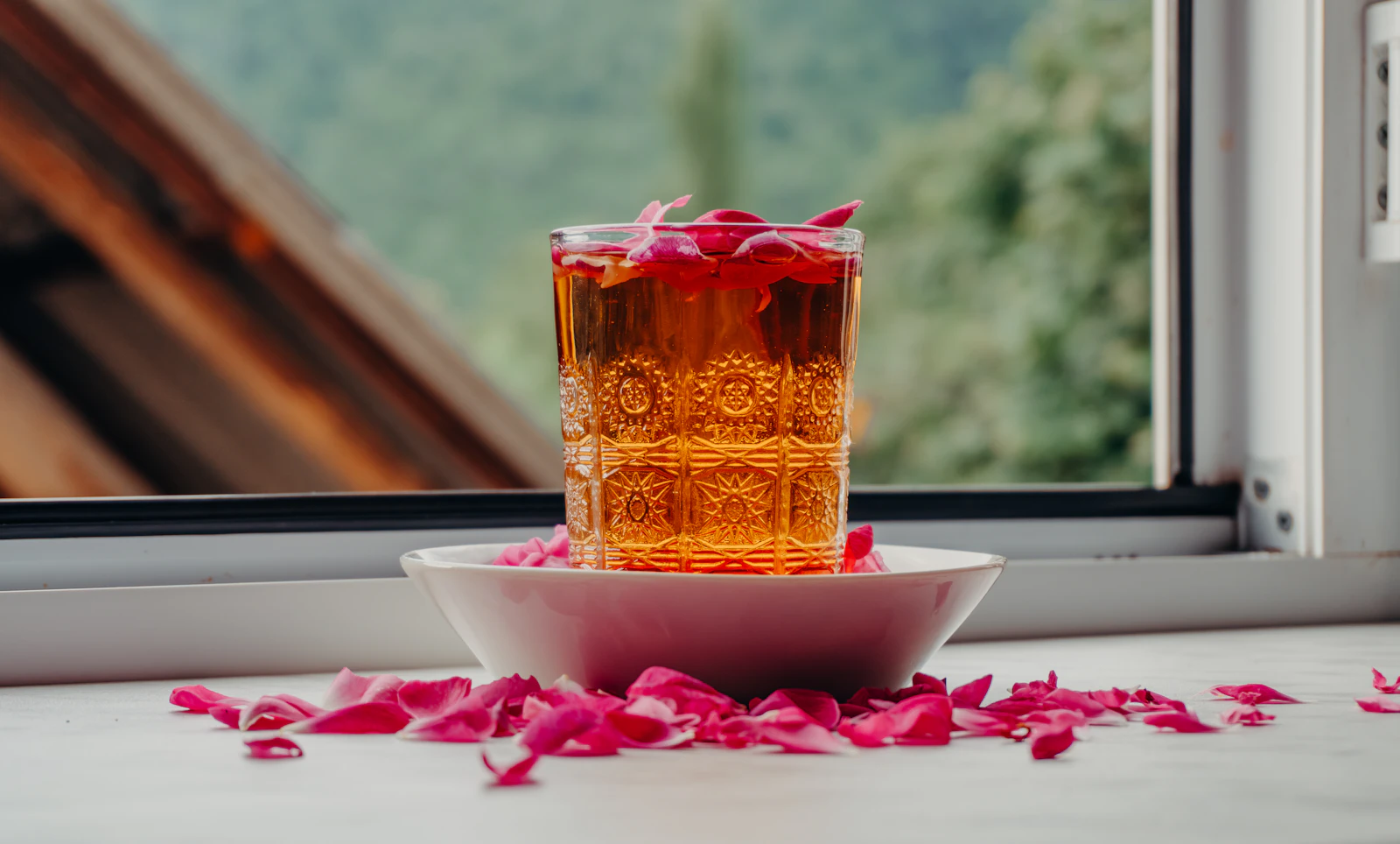
- Rosebud tea: Cover 5 g dried edible rosebuds (about six to eight buds) with boiling water for 10 minutes. Drink one cup daily starting a week before bleeding for shifting distension and irritability; see rose flower tea.
- Dried-tangerine-peel ginger and brown-sugar water: Simmer 3 g dried tangerine peel, three ginger slices, and about 15 g brown sugar in water for 10 minutes. Drink warm once daily during the premenstrual week for cold or distending heaviness.
- Chinese yam and millet porridge: Peel and cube 100 g fresh Chinese yam, then cook with 50 g millet in water for 30 minutes. Have it for breakfast when appetite and energy are low before the period.
Western route
- Ginger, jujube, and cinnamon tea: Simmer two or three fresh ginger slices (about 10 g), two or three split jujube dates, and ¼ teaspoon cinnamon (about 1 g) in water for 10 minutes. Drink warm as a supermarket version of the warming Eastern drink.
- Banana oats: Cook 50 g rolled oats in water or milk, add half a sliced banana and a pinch of cinnamon for a warm breakfast during the premenstrual week.
- Sweet-potato chicken soup: Peel and cube one sweet potato (about 200 g), then simmer with one chicken leg and two ginger slices for 40 minutes, salting lightly. Have it for dinner during the premenstrual week if cold heaviness responds to warmth.
- Choose warm over cold: For that week replace iced coffee, iced yoghurt, and raw salad with warm alternatives; both food routes begin with this basic step.
Qi-stagnation tendencies prioritize rose tea, yang deficiency the warming tea or chicken soup, traditionally used to warm the middle and move qi, and blood stasis movement alongside food. If flow is heavy, stop rose tea during bleeding; reduce brown sugar and cinnamon if you tend to feel overheated.
Emotional steadiness
Hormone changes can make irritability real before a period, while emotional tension can also intensify heaviness. Twice a day for three minutes, inhale four seconds and exhale six. Put a worry into words or write it down; if you need to sigh, let the breath go. A week beforehand, move the hardest avoidable negotiation or decision to another day. This is most relevant to qi stagnation but useful in any stressful cycle.
Movement
Walk briskly 20–30 minutes at a warm but conversational pace. Before bed, try butterfly stretch with soles together and knees relaxing outward for one or two minutes, or child’s pose for two minutes. The traditional focus is helping the premenstrual flow of qi and blood, especially for fixed pain. During the premenstrual week, replace high-intensity training with gentler work; hard effort adds stress hormones while hormones are already changing. With yang deficiency, avoid sweating heavily.
Sleep and daily rhythm
During the week before a period, aim to sleep before 11 p.m. Finish a warm dinner three hours before bed so a late, cold meal does not add to heaviness. On waking, drink a warm glass of water and take a few abdominal breaths while still under the covers before getting up, particularly when mornings feel cold and heavy. Steady routine can help any type; yang deficiency especially calls for warmth on waking.
The free constitution test shows relative tendencies across nine traditional types: emotional release for qi stagnation, warmth for yang deficiency, or daily movement for blood stasis. It is a self-observation aid, not a diagnosis.
Week-before symptom calendar
Begin seven days before the expected period, or after ovulation when breast fullness begins if cycles are irregular. Spend two minutes each night until bleeding starts:
| Item | Record | Example |
|---|---|---|
| Days until flow | Expected period is day 0; count backward | Five days before |
| Heaviness | Score 0–10 | 4 |
| Place and quality | Midline/left/right; heavy, distending, stabbing, cold | Just right of center, heavy |
| Start time | When it began today | 3 p.m. |
| Other feelings | Breast soreness, irritability, bloating, backache, cold | Sore breasts and irritability |
| Mood and stress | Score 0–10 and an event | 7, work presentation |
| Sleep | Hours and ease of falling asleep | 6.5 hours, slow to sleep |
| Relief | Heat, medicine, tea; score half an hour later | 20 minutes heat, down to 2 |
After two complete cycles, a recurring premenstrual date that resolves when bleeding begins points toward PMS timing; one-sided pain about two weeks before the next period lasting a day or two points toward ovulation; a widening window and climbing score needs assessment. ACOG asks for symptom records covering at least two cycles when evaluating PMS, so this calendar can travel with you to an appointment.
When to expect a change
Heat and pressure can be compared within half an hour during a flare and over two cycles for the peak score. Early use of an appropriate NSAID can be judged in the current cycle; failure still merits care. Compare warm food, less salt and caffeine, and sleep over two or three cycles. Irritability may settle before the physical heaviness, in one or two cycles of stress reduction; judge pain over two or three. If scores are unchanged or rising after careful adjustments, bring the calendar to a clinician.
When to see a doctor
Get an assessment if heaviness becomes more painful each month, begins to interfere with work or sleep, spreads to the entire cycle, comes with heavier or longer bleeding or bleeding between periods, resists usual medicine, or first appears after 25 and keeps worsening. Fever, pain during sex or bowel movements, and persistent one-sided pain after a missed period and positive pregnancy test also need care; the last needs urgent evaluation for ectopic pregnancy. After two or three cycles without improvement, bring the calendar to gynecology for review, examination, and possible ultrasound. This is health education, not individual advice. Ask a clinician before an NSAID if taking anticoagulants or living with an ulcer or kidney disease.
Common questions
Why does the heaviness disappear once my period starts?
That fits the PMS-like timing described here. Prostaglandin-driven “rehearsal” contractions are felt before bleeding; once flow begins, levels start to fall and heaviness can ease. Pain worst in the week before flow leans toward this pattern; pain worst on the first two days of bleeding leans toward classic period cramps. The calendar shows your own rhythm.
My cycle is only 24 days. How do I tell this from ovulation pain?
Count back roughly 14 days from the next expected period; in a 24-day cycle, ovulation is around day 10, not day 12 by default. Then compare location, duration, and companions: short one-sided pain without breast or mood changes favors ovulation; several days of central heaviness with breast tenderness or irritability favors a premenstrual pattern. If two calendars place a short one-sided ache near ovulation, it is ovulation pain rather than PMS arriving two weeks early. Heat and gentle movement can still be used.
Begin with timing, then choose everyday care. See period pain, how long cramps should last, non-medicine relief, and the PMS overview.
Your cramps start a week early. Which daily-care step fits first?
A distending ache with irritability, cold pain that welcomes warmth, and pain fixed in one spot suggest different first steps in traditional care. The free constitution test shows tendencies across nine traditional types to help you explore them. It is for self-observation, not medical diagnosis.
References9 sources
- 01
- 02
Cleveland Clinic
- 03
MedlinePlus
- 04
Mayo Clinic
- 05
Mayo Clinic
- 06
- 07
- 08
- 09Huangdi Neijing, Suwen
Traditional Chinese medical text
Personalized guidance
Use the app for constitution-friendly ideas and structured plans when available.
Download the App
Get personalized TCM health recommendations