Why Do I Sweat So Much in My Sleep? Nine Common Causes of Night Sweats
Waking up damp can be a warm duvet — or a signal from medication, infection, perimenopausal hormones, or thyroid trouble. A cause-by-cause checklist to tell harmless sweat from sweat that needs a doctor.
By WellTao · Published: · Editorial Policy
More articles in this topicTable of contents
The Short Answer First
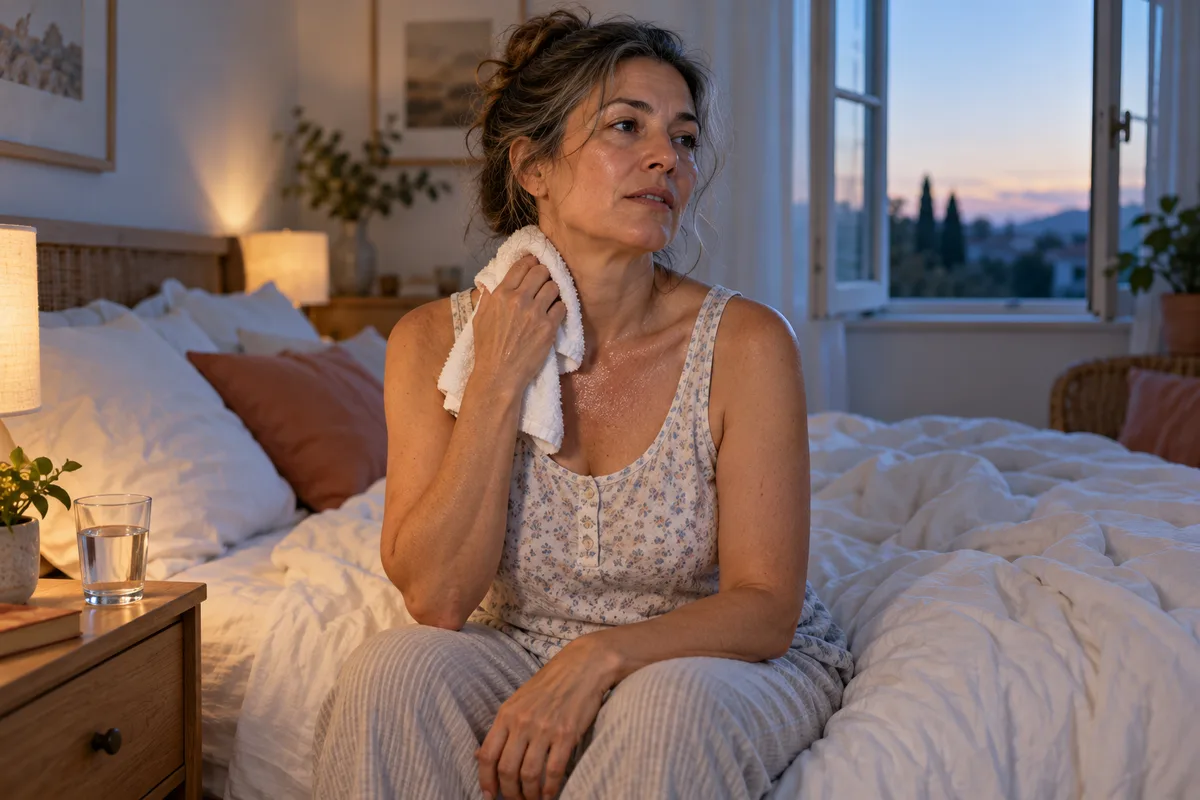
Occasionally waking up damp is usually just the bedroom temperature, the duvet, or yesterday’s workout catching up with you — not a disease. Mayo Clinic’s definition sets the bar higher: true “night sweats” means repeated, heavy sweating that soaks your pajamas or sheets. Simply feeling warm at night doesn’t qualify.
The causes actually worth checking, roughly in order of how common they are: perimenopausal hormone swings, a hot bedroom and heavy bedding, medications that impair temperature regulation, infection and fever, anxiety, endocrine problems such as an overactive thyroid, sleep apnea, obesity, and — rarely — blood disorders. The list follows Cleveland Clinic’s breakdown of night-sweat causes.
Start with the one-week diary at the end of this article and observe for a week or two; most people find a clear environmental or lifestyle trigger. If heavy episodes are soaking your clothes several nights a week, or they come with unexplained weight loss or recurring fever, skip the bedding experiments and go straight to when to see a doctor.
Which Kind of Night Sweat Is Yours
Match yourself against these five profiles:
- Environmental: you wake slightly damp, a lighter duvet fixes it, daytime sweating is normal and nothing else feels off. The largest group by far. Nothing to treat.
- Hormonal: around 40, periods changing, heat waves rising from your chest at night — sometimes followed by a chill after the sweat; daytime hot flashes may tag along.
- Medication: night sweats began after you started a new drug. Antidepressants, fever reducers, hormonal medications, and diabetes drugs are all on Mayo Clinic’s list — worth checking line by line.
- A body signal: night sweats with fever, noticeable weight loss, weeks of uninterrupted drenching sweat, or one-sided pain. Don’t self-diagnose this line. Go to the doctor.
- Emotional: during stretches of stress or anxiety the sweats multiply, usually with a racing heart and vivid dreams.
Cleveland Clinic also flags an often-missed point: withdrawal from alcohol can itself cause night sweats, and heavy ongoing drinking can too. A glass or two of wine now and then doesn’t put you in this group, but if you drink nightly or recently stopped, factor that in.
What Modern Medicine Says
How sweating works: a cooling system with a thermostat. Sweat glands in the skin receive a signal, release fluid, and evaporation carries heat away. The reason Mayo Clinic’s definition insists on “heavy and repeated” is that ordinary nighttime warmth usually just means your bedding pushed past the thermostat’s expectations.
Why menopause is cause number one. Estrogen doesn’t regulate body temperature directly; it shapes how sensitive your temperature-control center is to change. Per Cleveland Clinic’s explanation, as ovarian function fluctuates and estrogen falls in perimenopause, the “acceptable range” narrows — the smallest shift in ambient temperature triggers a full-scale cooling response, sweat included, all at once. At night there’s no reason for the glands to switch off, which is why the reaction shows up most dramatically as waking up soaked.
Why medications play their part. Some drugs act directly on temperature-regulation pathways: antidepressants work on neurotransmitters, and the autonomic nervous system runs sweat too; fever reducers deliberately open the sweat tap; hormonal medications, insulin, and glucose-lowering drugs shift metabolism and blood-sugar rhythms. The test is simple — timing. If night sweats started when a medication started or changed, that’s the key clue for the “medication” profile. Don’t stop the drug yourself; bring the timeline to your doctor.
A few directions to rule out quickly. Fever (including the low-grade tail end of a cold) switches the nighttime cooling machinery on; overactive thyroid raises your metabolic rate so the body runs hot around the clock; sleep apnea causes repeated nighttime oxygen drops and an overactive sympathetic system; obesity makes dissipating heat harder. What these have in common: night sweats are one symptom among several, never the only one.
How Chinese Medicine Reads Sleep Sweating
Traditional Chinese medicine compresses “sweating at the wrong time” into one line from the Suwen: “yang added to yin makes sweat.” Sweat results from yang qi moving the body’s fluids to the surface. Normal sweating is that cooling function doing its job; abnormal sweating signals a loss of balance between the two.
The framework’s most basic split is spontaneous sweating vs. night sweats:
- Sweating while awake, worse with the slightest activity is spontaneous sweating, traditionally blamed on qi deficiency failing to secure the body’s surface — the “gatekeeping wei qi has gone slack.”
- Sweating while asleep, stopping on waking is the classic night sweat, explained as internal heat from yin deficiency: after you fall asleep, defensive yang moves inward, the heat this stokes “opens the gate,” and fluid leaks out; on waking, yang returns to the surface and the sweat dries. Night sweats with strong heat sensations, warm palms and soles, and a dry mouth usually follow this route.
Mapped onto heavy sleep sweating, the traditional and modern pictures align loosely. The tradition tracks when you sweat and what else you feel in the moment; the modern list tracks specific diseases. They don’t contradict each other, but neither is a translation of the other (see NCCIH’s overview of traditional Chinese medicine for where the system stands on evidence).
Within the framework, three nighttime patterns show up most often:
- Heat-wave sweating: a surge rising through the chest, flushed cheeks on waking, warm palms and soles, shallow sleep — traditionally internal heat from yin deficiency flaring upward.
- Profuse sweat with fatigue: drenching sweat, waking drained, spontaneous sweating by day with mild exertion — traditionally the balance between holding in and letting out slipping toward letting out.
- Sweat with restlessness: sweating alongside agitation, trouble falling asleep, vivid dreams, a bitter or sticky taste, without obvious signs of deficiency — traditionally associated with internal damp-heat and stuck qi flow.
Traditional constitution theory uses categories such as yin deficiency, qi deficiency, and damp-heat to describe wellness tendencies. The direction runs one way: someone with a yin-deficiency tendency should watch for afternoon heat sensations and nighttime dry mouth; a qi-deficiency tendency calls for attention to sweating on exertion and easy fatigue. The reverse doesn’t hold — night sweats alone don’t make you “yin deficient.” One person can carry several patterns at once, and patterns shift with season and sleep. A licensed practitioner does the actual pattern differentiation in person.
Everyday Adjustments
Two tracks — environment and body — ordered by priority:
- Actually lower the bedroom temperature. Cleveland Clinic suggests a cool room, a fan, and a glass of cool water on the nightstand to sip anytime. For most people 18–20°C (65–68°F) sleeps steadily; what matters more than “feels cool” is not sleeping under a heavy duvet.
- Layer the bedding. Thin duvet plus a blanket you can throw off; cotton or linen pajamas, not synthetics or fleece. Dropping a layer the moment a hot flash arrives beats remodeling the bed afterward.
- Audit the day’s heat habits. Spicy food after dinner, alcohol, caffeine, and a very hot bath (a hot soak briefly raises core temperature) are the four most common changeable triggers. Pause each for a night and watch what the diary says.
- Check your medications. Put the start date of each new drug next to the date night sweats began, on one sheet of paper, and bring it to your next appointment. This is the single most effective step toward the “medication” answer.
- Record before you conclude. Sleep sweating depends on the room, the bedding, and the day all at once; a single night means nothing. Collect two weeks before you decide anything.
Chinese Medicine Methods
The five categories below center on nighttime sweating, each marked with the constitution it suits and the cautions. All food therapy here uses food amounts; consult a practitioner before using any ingredient as a medicinal herb.
Acupressure
Ideally within 30 minutes of bedtime; use fingerpads or small circles, pressing to a comfortable ache:
- Hegu: the highest point of the muscle between thumb and index finger. Traditionally used to move the body’s qi and hold sweat at the surface; press each side 60–90 seconds. Do not use during pregnancy (traditionally considered to possibly stimulate uterine contractions).
- Sanyinjiao: four finger-widths above the inner ankle bone, just behind the shin edge. Traditionally nourishes yin and blood; press 60 seconds for the heat-wave pattern. Note: this point is contraindicated in pregnancy; if you have a bleeding tendency or take medication, check with a professional first.
- Yongquan (soles): the hollow in the upper third of the sole, where the toes curl. Traditionally draws heat downward; soak feet in warm water for 10 minutes (about 40°C, not scalding), then press each side for a minute — a good closer for the heat-wave type.
Cautions: with broken skin or diabetic neuropathy, keep the foot-soak temperature the same as anyone else’s and under 10 minutes; stop immediately if pressing hurts.
Food Therapy
Eastern-style:
- Bamboo-leaf and cogongrass-root drink: 3g bamboo leaf (or bamboo-leaf tea) and 10g dried cogongrass root steeped in 500ml boiled water, covered 10 minutes. Traditionally clears heat and eases restlessness; suits the restless-sweat type. Skip it regularly if your digestion runs cold or your stools loosen easily.
- Tremella and lily soup: half a tremella head, soaked and torn, with 10g dried lily bulbs simmered 40 minutes in 500ml water; little or no rock sugar. Traditionally moistens yin and dryness for nighttime dry mouth with heat-wave sweats; omit sugar if you’re limiting it.
- Goji and chrysanthemum millet porridge: 40g millet with 10 goji berries; off the heat, rest 5 minutes, then float 5 chrysanthemum flowers (don’t boil them). A warm breakfast for the heat-wave type; goji runs mildly warm — leave it out if damp-heat signs are strong or you have an active infection.
Western-style:
- Oat-and-banana cup: 40g oats simmered 5 minutes in 200ml milk, with half a banana and a handful of blueberries. Oats’ soluble fiber steadies blood sugar, which can take the edge off nighttime restlessness; finish at least 2.5 hours before bed.
- Warm chamomile milk: 250ml warm milk with a chamomile tea bag steeped 3 minutes. A standing replacement for the habitual evening drink — swapping alcohol for this cup helps both temperature regulation and sleep.
- Room-temperature baseline dinner: brown rice + sautéed zucchini + some egg. Avoid the seductive-sounding “spicy food to sweat yourself sleepy” — on sweat-prone nights a spicy dinner keeps the glands on call until morning.
Emotional Regulation
The point of emotional work for sweat isn’t suppression; it’s lowering the nervous system’s load. In the last 10 minutes before bed, do 4–7–8 breathing (inhale 4 seconds, hold 7, exhale 8, three or four rounds) with attention on the sense of release as the breath leaves. Extended exhalation directly activates the parasympathetic system, which shares wiring with your sweat rhythm. If anxiety and night sweats clearly track each other, make this the fixed last act of the evening; if a month later nothing has changed, that situation won’t yield to breathing alone — see the next section.
Movement
Thirty minutes a day of brisk walking or low-intensity cardio, in the morning or after sunset, never within two hours of bed — post-exercise cooling takes time, and evening workouts smuggle the heat into your covers. Cut the total in half and split it morning/evening if you tend toward qi deficiency; try the Baduanjin move that strengthens the kidneys and waist from Baduanjin qigong, 8–10 slow reps, easy enough to sustain for months.
Sleep Routine
- Fix your bedtime and wake time within a 30-minute window. Once the rhythm steadies, the nighttime temperature-drop curve smooths out and the sweating window shrinks.
- Finish dinner 3 hours before bed and your shower 1.5 hours before: both give your core temperature time to fall before bed.
- Air out the bedroom for 10 minutes pre-sleep, directly lowering your starting room temperature.
Three patterns, three directions — that’s the question the traditional constitution framework exists to answer. The free constitution test at the end of this article can point you toward your tendency; a self-observation tool, not a diagnosis.
The One-Week Sweat Diary
The hardest part of troubleshooting night sweats is that the clues are scattered. For one week, spend one minute every morning on four entries:
| Entry | Example |
|---|---|
| Last night’s sweat level | dry / slightly damp / pajamas wet / sheets soaked |
| Three factors from the previous day | room temp, dinner (spicy / alcohol / caffeine), mood |
| Accompanying sensations | heat feeling, palpitations, trouble falling asleep, vivid dreams |
| Where you are in your cycle | days since the first day of your last period (to line up with the hormone cycle) |
After a week, review: if sweat level and one factor show up together twice or more, that factor becomes your first fix. If no pattern emerges and heavy sweating still hits twice or more a week, move straight to the doctor list.
This is a self-observation tool, not a diagnostic scale — it maps sweat to your nights, not to a disease name.
How Long Until It Helps
- Environment and bedding: visible in the sweat-level column the same night, certainly within days.
- Dinner and pre-bed intake: compare from the next day on; the link with spicy food or alcohol usually declares itself within a night or two.
- Food therapy and constitution work: traditionally measured in weeks — expect to check in every two weeks rather than overnight; if things worsen instead, return to the doctor boundary. No diary predicts exactly when symptoms will ease; individual responses vary widely.
When to See a Doctor
Mayo Clinic’s thresholds are clear. See a doctor promptly if any of these apply:
- night sweats occur regularly or disrupt your sleep;
- they come with fever, weight loss, persistent pain in one spot, cough, or diarrhea;
- they reappear months or years after menopause symptoms had ended;
- they come with sustained palpitations, chest pain, labored breathing, or confusion — seek care immediately.
One practical note: if the night sweats started right after you began a new medication, hand this timeline to the doctor before any change is made. Don’t stop the drug on your own. This article is general health information, not a substitute for diagnosis or individualized advice.
Common Questions
I sweat during the day too, but nights are worse. Same problem?
Usually the same issue, amplified. By day it’s mild extra warmth; at night, lying down under bedding with the parasympathetic system in charge concentrates the heat load. Start with the environmental checklist. If your daytime sweating itself is far beyond normal, look into hyperhidrosis and have a dermatologist assess it if needed.
Why do pregnancy and postpartum bring more night sweats?
The sharp hormonal swings of pregnancy and the postpartum period also reshape temperature control; Cleveland Clinic lists pregnancy and postpartum among common causes. This group usually fades as breastfeeding winds down, but confirm with your obstetrician either way.
Is it normal to shiver after the sweat stops?
Sweating is the body dumping heat; shivering is the rebound as temperature overshoots downward. Around menopausal hot flashes the full heat—sweat—chill loop is common. On its own it’s nothing alarming; if you also suspect your thyroid (racing heart, weight loss, hand tremor), add them to what you tell the doctor.
For the wider picture of this life stage, read the menopause hub; when sweating comes with being unable to sleep all night and no daytime energy, see perimenopause insomnia and night sweats plus fatigue.
Same soaked pajamas, different root: for some it's yin deficiency, for others qi that won't hold sweat in
Traditional wellness links your sweating pattern to your constitution. The free constitution test maps your tendencies across nine traditional types and pairs well with the one-week sweat diary below. For self-reflection, not medical diagnosis.
References4 sources
- 01
Mayo Clinic
- 02
Cleveland Clinic Health Essentials
- 03
U.S. National Center for Complementary and Integrative Health (NCCIH / NIH)
- 04
Cleveland Clinic
Personalized guidance
Use the app for constitution-friendly ideas and structured plans when available.
Download the App
Get personalized TCM health recommendations