Night Sweats and Fatigue Together: The Two-Week Sorting Map
Night sweats plus daytime tiredness usually points at perimenopause — but not only. The four combinations, the two-week self-sort, the bloodwork bottom line (CBC, ferritin, TSH), and the red lines that go straight to a doctor.
By WellTao · Published: · Editorial Policy
More articles in this topicTable of contents
The Short Answer First
When “sweating at night + tired during the day” arrive together, the most common single explanation is perimenopausal hormone fluctuation: night sweats shred sleep, and a short-slept day is a tired day — the NIA describes this pairing officially. But the research keyword is “not only”: the pair can also be assembled from a few specific, checkable causes — Cleveland Clinic’s night-sweats piece reminds that the list behind them includes infections, thyroid problems, low blood sugar, and certain medications.
So this article is structured as a sorting map: a two-week combined check (the method section and log below) separates “hormone-linked” from “other causes.” The hormone-linked signature is flash-shaped, wave-like sweat, at perimenopausal age, synced with menstrual change; the check-me-now red lines are drenching sweats that persist, fever or weight loss alongside, and clear daytime symptoms. The two entry doors differ — walking through the right one is what saves you a wasted month.
The good news: whichever cause finally wins, three moves are worth starting tonight — nighttime cooling, sleep-structure repair, and a bloodwork backstop. They pay on every branch of the map.
Which Combination Is Yours?
Four common shapes, each starting somewhere different:
- Flash-shaped night-sweat type: wave-like, rising from the chest, lasting an hour or longer; occasional daytime flashes — the hormone-led, most common combination.
- Fragmented-sleep type: the sweat itself is moderate (one damp layer), but wakings run three or four a night and the daytime is cloudy between “sleepy” and “tired” — sleep-quality-led (time and duration, not just sweat).
- Anemia/thyroid type: light but persistent sweats, marked fatigue, palpitations and breathlessness, cold- or heat-intolerance, heavy periods — this type’s answer lives at the clinic; bloodwork before anything else.
- Whole-body alarm type: sheets and clothes soaked through, episodes more frequent than they should be, every week, with fever, weight loss, or local symptoms — not a self-management case; straight to a doctor (the red lines below).
The value of the split: types one and two do their work in the bedroom and the pre-sleep hour; type three’s main move is a blood draw; type four steps past self-help entirely. The two deeper topics each have their own article — why you sweat in your sleep and menopause fatigue.
What Modern Medicine Says
How wide the overlap runs. From the NIA’s sleep pages: night sweats and flashes report high in perimenopause, and they string the daytime fatigue, mood, and thinking problems together by wrecking sleep depth. In other words, “sweating at night + no energy during the day” is very common in perimenopausal women — but “common” is not the same as “the only explanation,” which is exactly why the bloodwork backstop exists below.
The full cause list for night sweats. Cleveland Clinic’s sorting directions:
- Hormone changes (still the first item in perimenopause);
- Infections (tuberculosis and others can carry nighttime fever and sweat — unlikely to be “menopause,” but excluded because of the symptom pairing);
- Thyroid problems (over- and under-active both write the same “sweat + fatigue” answer);
- Medications (some antidepressants, glucose-lowering drugs, and others);
- Low blood sugar / alcohol / sleep apnea;
- Idiopathic night sweats (some genuinely have no findable cause — an acceptable label once the rest of the list is excluded, and management continues anyway).
Read the list not as “it’s all me,” but as “after checking, claim only what’s yours” — anemia and thyroid are the two worth investigating first (the doctor section), because they’re checkable, treatable, and pay clearly.
The checkable causes of fatigue are just as sharp. Iron deficiency, thyroid dysfunction, and sleep apnea are fatigue’s three most common reporters — heavily overlapping the sweat-side list (which is the combination’s whole value: one workup often covers both ends). The panel is CBC + ferritin + TSH; loud snoring adds one sleep-evaluation referral.
How Chinese Medicine Reads Night Sweat with Tiredness
The tradition’s classic labels for this pairing are yin-deficiency night sweats and dual qi-and-yin deficiency:
- Yin deficiency, night sweats: the sweating runs on “internal heat pushing fluids outward”; the signature is localized sweat, followed by exhaustion and a dry mouth; the traditional direction is “enrich yin, restrain sweat.”
- Yang deficiency, spontaneous sweat + qi-deficiency fatigue: the other pairing — sweating from ordinary daytime activity plus overall running on empty, read as “qi failing to hold sweat”; the direction is build qi, secure the surface.
- Blood and yin both short (heart and spleen): sweat with palpitations, poor complexion, heavy periods — the traditional counterpart of the heavy-menstrual anemia curve.
The model treats sweat as “the gate of fluids not closing” — and the loose gate splits two ways: not enough water (yin deficiency) or not enough qi (qi deficiency), with opposite directions (traditional model; the modern evidence boundary sits in NCCIH’s overview).
Constitution links: yin deficiency (the night-sweat mainline), qi deficiency (the day-sweat-plus-fatigue mainline), yang deficiency (day sweats with cold sensitivity). Tendency informs pattern in one direction; “water or qi” is precisely the judgment a practitioner earns at the desk.
The Two-Week Sort
Step one (week 1): test whether the sweat is “hormone-shaped.”
- Log every night sweat: time, quantity (how much of the sheet), whether it came as a wave rising from the chest; count daytime flashes too.
- Log your period state alongside (date and character of the last cycle).
- Hormone-linked means the three line up: wave-shaped sweat, perimenopausal age, menstrual change.
Step two (same week 1): put the universal measures in place.
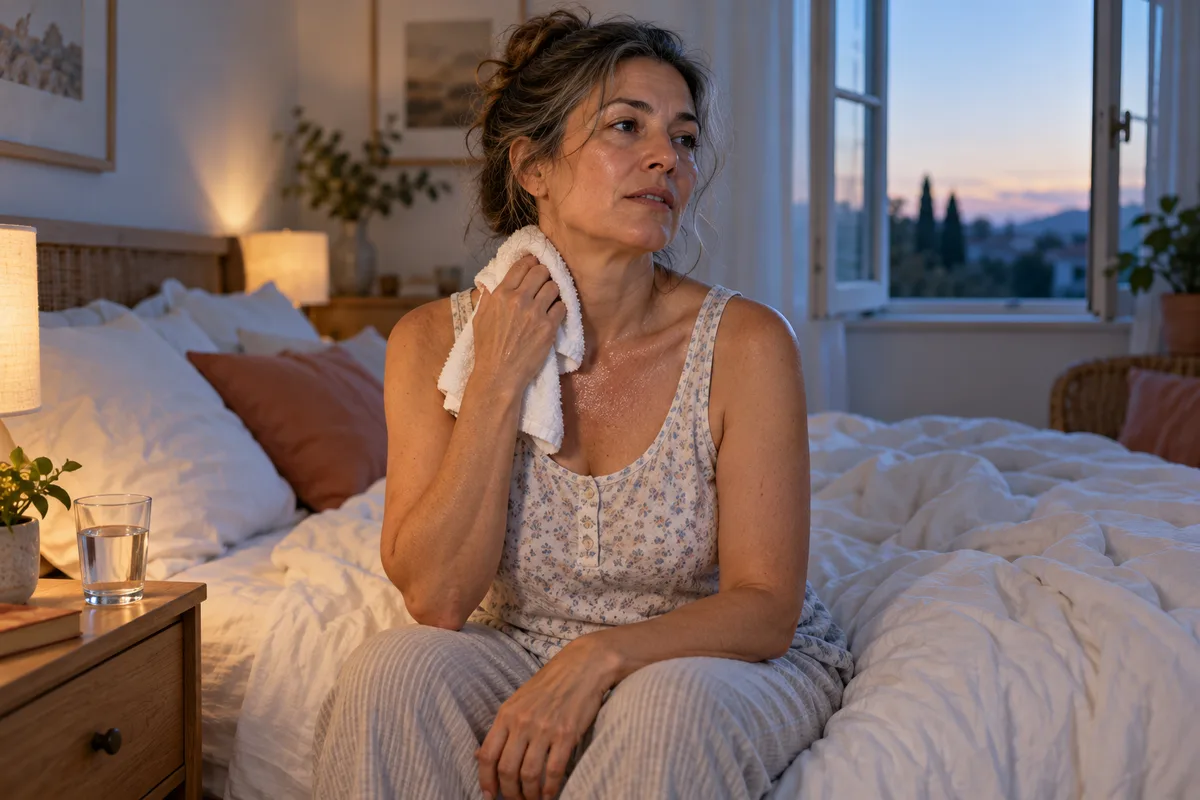
- The nighttime cooling four-pack (fan, cool water, a towel at hand, layered bedding) — full operation in the night-sweats article.
- The sleep structure (fixed wake time, caffeine ends midday, screens off an hour before bed) — in perimenopause insomnia.
Step three (week 2): cross off the “not hormones” items.
- Medication inventory: bring every long-term pill (supplements included) to one doctor question: “any sweat-and-sleep options among these?”
- Alcohol and dinner: late-and-heavy dinners, evening drinks, and an overheated bedroom are three “looks like a symptom, actually environment” sweat sources — zero them all in week 2 and watch.
- Snoring check: ask the household “was the snoring loud?” or record a clip; loud snoring + heavy daytime sleepiness is sleep apnea’s first-screen hint.
Step four (end of week 2): decide on testing.
- Any one of these four “go now” triggers: sweats and fatigue not improving; drenching sweats more than twice weekly; fever, weight loss, or palpitations alongside; periods still gaining volume.
- Even if nothing triggers, book the bloodwork anyway (CBC + ferritin + TSH) — the cheapest panoramic lens on the whole map.
Chinese Medicine Methods
Five categories for the sweat-plus-fatigue pairing, each marked with the tendency it suits and cautions. Food therapy uses food amounts; consult a practitioner before using any ingredient as a medicinal herb.
Acupressure
- Yinxi (above the inner end of the wrist crease, between the two tendons): the tradition’s dedicated “restrain yin, stop sweat” point for night sweats; both sides, 60 seconds before sleep.
- Taixi (hollow between the inner ankle and Achilles tendon): the enrich-kidney-yin anchor; 60 seconds around 9 p.m. — the daily center of gravity for the yin-deficiency type.
- Zusanli + Qihai (two finger-widths below the navel): the build-qi pairing for the qi-vacuity, day-sweat-and-fatigue type; mornings, 60 seconds each.
- Sanyinjiao (four finger-widths above the inner ankle): the general aid for the type short on both qi and blood; absolutely contraindicated in pregnancy.
- A direction reminder: the yin route runs on “evening,” the qi route on “morning” — swapped directions routinely halve the effect.
Food Therapy
Eastern-style:
- Schisandra millet porridge (the night-sweat type’s flagship): 3g schisandra berries (in a cloth bag) with 40g millet, simmered 30 minutes, warm at dinner — the traditional “restrain yin, stop sweat” recipe, gentle for the long run; use with care if stomach acid runs high; consult first in pregnancy or on medication.
- Mulberry and smoked-plum drink: 10g dried mulberries + 2 smoked plums simmered in water, warm in the afternoon — the sour-closing, yin-feeding helper tea; fewer plums if stomach acid is already high.
- Astragalus chicken stew (qi-deficiency type): 15g astragalus with 300g chicken, stewed 60 minutes, once or twice weekly — the tradition’s famous “secure the surface, build qi” formula at home-cooking portions; skipped during colds and fever, and not for the yin-heat flash type.
- Goji chrysanthemum tea: the yin-vexed type’s afternoon tea (same household as the skin article’s pairing).
Western-style:
- Iron and protein first (the fatigue end): lean red meat two or three times weekly + leafy greens daily + citrus alongside for absorption; heavy-period women apply this one before any other.
- Dinner structure: cool temperature, small portions — a big meal’s evening heat-production is night-sweat fuel; leave three hours between dinner and bed.
- Evening alcohol goes to zero: alcohol touches the sweating, the sleep, and the fatigue at once — more damaging here than almost anywhere. Two zero-weeks is the move that pays on every branch.
- Add a water allowance: night sweats lose fluid, so daytime runs 1.5–2 liters with an extra notch; warm water between meals, none right up to bedtime.
Emotional Regulation
- A standing recovery slot: 20 minutes of daytime “doing nothing, phone nowhere in hand” — separating the fatigue that belongs to emotional battery drain from the rest.
- The fixed wake-hot routine: towel → swap to the dry side of the sheet → two sips of water → three slow exhales — no phone, no clock. Full detail in the night-sweats article.
- One honest tuning conversation at home: “I’m sorting out night sweats and fatigue for two weeks; there may be some motion at night” — it spares the household unexplained disturbances, and you the extra layer of “I said it and nobody understood.”
Movement
- Mornings lead: 30 minutes of brisk walking or swimming in the daytime (for the night-sweat type), with longer warm-up and cool-down in a cooler space — “fully active days, quiet by evening” is the ideal day-shape here.
- Baduanjin qigong, 15 minutes daily: for the “no strength in the day” feeling, this gentle whole-flow practice is steadier than harder training — and survives the long run.
- No hard evening exercise — it delays both body temperature and neural settling, feeding night sweats and wakings alike.
Sleep and Routine
- A fixed wake time (the single highest-value move, ahead of total hours); ten minutes of morning light.
- Bedroom temperature: cool-ish sleep is baseline for this pairing — 18–20°C to start in winter (tuned to the person), and no relearning into “I can only sleep under extra covers.”
- No evening alcohol, no afternoon caffeine — both touch all three ends: sweat, sleep, fatigue.
Four combinations, four different focuses — the three universal measures come first, then each type adds its layer. The free constitution test at the end of this article is a self-observation tool, not a medical diagnosis.
The Self-Check Log and Matrix
The log (a two-week template):
| Entry | Week 1 | Week 2 |
|---|---|---|
| Night wakings (average) | × / night | × / night |
| Night-sweat amount (clothes / sheets / patchy) | ||
| Flash-shaped (chest wave) share | ||
| Daytime energy score | ||
| Palpitations / breathlessness count | ||
| Period state | last one’s date & character | same |
| Evening alcohol | × times | 0 |
The matrix (reading the log):
| Finding | Main lever | Where to read deeper |
|---|---|---|
| Flash-shaped sweats dominate | nighttime cooling + trigger audit | night sweats, hot flashes |
| Many wakings, sweat moderate | sleep structure | perimenopause insomnia |
| Light sweat, heavy fatigue, palpitations, heavy periods | bloodwork first (iron / thyroid) | menopause fatigue |
| Sweats mostly from alcohol, dinner, room temp | zero them from week 2, then re-read | step three of this article |
| Drenching sweats 2+ times weekly, or other whole-body signs | straight to a doctor | the doctor section |
How to use: the two-week sort’s direct goal is fishing out the matrix row that says “see a doctor” — the log can’t diagnose, but it points to where the next move lives: the bedroom, the table, or the lab.
How Long Until It Helps
- Cooling and sleep structure: comfort-after-waking improves the same night; waking counts get re-read at two weeks — the fastest-paying of the universal measures.
- Alcohol and dinner zeroed: both ends usually move within two weeks; this is also the cleanest experiment for “how big is the environment share.”
- The movement re-shape (active mornings, quiet evenings): the daytime energy score climbs from week 2.
- Food therapy and constitution work: the first observation window spans two-to-four weeks, scored on two points together — night-sweat amount + morning energy.
- Targeted care after bloodwork findings (iron, say): the fatigue end moves on a weeks-to-months clock; “check first, treat second” is this combination’s heaviest-weighted principle.
- The honesty line: symptoms mostly ease once the hormones settle — but “waiting to settle” isn’t a plan; everything above starts tonight.
When to See a Doctor
Four “go now” red lines:
- Drenching sweats soaking clothes or bedding, three or more nights weekly, no improvement past two weeks;
- Sweats with fever or unexplained weight loss (marked unintentional loss within two months);
- Sweats with coughing blood, nighttime chest pain, recurring joint pain, or other whole-body signs;
- Fatigue with persistent fever or specific oddities (palpitations nothing explains, marked jaundice and the like).
Two “check first, talk after”:
- The bloodwork backstop hasn’t been done (CBC + ferritin + TSH) — even when things “look like they’re improving,” one panel is worth it;
- Loud snoring + heavy daytime sleepiness — sleep apnea’s first-screen pair; a sleep evaluation referral follows.
Two “evaluate together”:
- Perimenopausal symptoms past two weeks and already reshaping life: see the fatigue article’s doctor section (CBT-I and the medical direction included);
- Periods still gaining volume or touching ACOG’s abnormal-bleeding lines — evaluated in the same visit as the sweat-fatigue picture.
This article is general health information, not a substitute for diagnosis or individualized advice.
Common Questions
So is it menopause or something else?
Both answers stay true: perimenopause is one of the most common backdrops for night sweats (the hormone swing’s temperature amplification), and the checkable list behind them is real and complete (thyroid, infection, medications, sleep apnea). The workable move is both lanes at once — cooling and sleep repair start now (they pay under any explanation), and if two weeks pass without improvement or whole-body signs are present, the bloodwork lane takes over. When sweats, flashes, and menstrual changes move together, the menopause reading naturally rises in priority.
I sweat from any little activity and tire easily. Is my qi just “gone”?
The day-sweat-plus-fatigue pairing needs the direction split first too: in the traditional frame, “qi-vacuity spontaneous sweat” and “yin-deficiency night sweat” run opposite care directions (build qi vs. enrich yin), and reversed directions routinely feel worse. The modern view has checkable causes for daytime sweating with tiredness as well (thyroid, anemia). So the fitting answer is: bloodwork first, then settle the constitution direction — the lab and the pattern reading complete each other.
Should I eat more and “build myself up” at night?
No — a late, heavy dinner feeds both the night sweats and the shredded sleep (the body’s evening digestion genuinely produces heat). Dinner stays cool-temperature and light, three hours ahead of bed; the “building” belongs to the daytime structure (iron, protein, water), not to a late load the body has to carry in its sleep.
For the full night-sweat picture, read why you sweat in your sleep; the fatigue-side frame sits in the fatigue hub; the sleep repair in perimenopause insomnia.
The night-soaking type and the day-sweating, low-energy type pull the traditional care in opposite directions
The free constitution test maps your tendencies across nine traditional types and pairs well with the two-week log below. For self-reflection, not medical diagnosis.
References3 sources
- 01
U.S. National Institute on Aging (NIA / NIH)
- 02
Cleveland Clinic Health Essentials
- 03
U.S. National Center for Complementary and Integrative Health (NCCIH / NIH)
Personalized guidance
Use the app for constitution-friendly ideas and structured plans when available.
Download the App
Get personalized TCM health recommendations