Why Does Travel Cause Constipation? Four Disruptions and a Packing-List Fix
Travel constipation is a real phenomenon: shifted schedules, unfamiliar toilets, hours of sitting, and irregular food and water all break bowel rhythm at once. What each disruption does, what to do before and during a trip, and how long recovery should take after you're home.
By WellTao · Published: · Editorial Policy
More articles in this topicTable of contents
The short version
Getting constipated on trips isn’t in your head, and it isn’t a mysterious reaction to foreign water. NIDDK’s list of constipation causes explicitly includes travel and changes in routine. Travel disrupts all four supports a bowel movement depends on at once: your schedule shifts, the bathroom is unfamiliar, you sit for hours in transit, and your drinking and eating go irregular. The gut is a rhythm-dependent organ — pull four pillars and the bowel goes on strike.
Travel can disrupt meals, activity, bathroom access, and daily routines, any of which may affect bowel habits. Keeping familiar meals, drinking according to your needs, moving when practical, and allowing time to use the bathroom may help. How quickly bowel habits settle varies from person to person; the checklist below offers ideas to try.
Which kind of travel constipation
- Short-trip type: a work trip or weekend away may temporarily change routine; symptoms and recovery vary.
- Long-haul type: cross-timezone flights or trips over a week, with constipation persisting days after return — jet lag compounding the sitting. Actively rebuild rhythm.
- Bathroom-avoidant type: can’t go in unfamiliar or public restrooms, holding it until home — chiefly psychological, with specific workarounds below.
- Fragile-baseline type: bowel rhythm is shaky even at home, and travel is just the last straw — build the everyday rhythm first via the constipation hub.
What modern medicine says
Bowel rhythm is trained, and travel cancels the training. Some people have a regular time when they feel the urge, often after a meal. Travel may change waking, meal, and bathroom routines, and delaying an urge can contribute to constipation. These effects vary by person.
Long periods of sitting may be one factor. Travel can also change meal timing, fluid intake, activity, sleep, and bathroom access. If you are limiting fluids to avoid bathroom stops, try to drink according to your usual needs unless a clinician has advised you to restrict fluids.
An unfamiliar or less private bathroom may make some people less comfortable using the toilet. Defecation is one of the few bodily functions that requires active relaxation, and some people may feel tense in unfamiliar, non-private settings, which can make it harder to relax (see can stress make you constipated). Holding it carries a second cost: stool may become harder when it remains in the colon longer.
Jet lag disrupts more than sleep. Crossing time zones can disrupt sleep and daily routines, which may affect bowel habits. The duration of adjustment varies; there is no fixed recovery time per time zone.
How Chinese medicine understands it
In the traditional Chinese medicine (TCM) framework, this falls under “disordered daily life and irregular meals.” Traditional wellness takes regularity far more seriously than modern life does — eating, resting, and defecating on schedule were considered foundational, because the frame holds that the body’s qi runs on its own hourly rhythm, and when daily life goes chaotic, qi goes chaotic with it. Travel breaks all three at once: meal times shift, sleep windows move, and the time and place for the toilet disappear entirely.
Travel fatigue adds a second layer the tradition calls “toil spends qi”: long journeys, luggage, and tight schedules all draw down qi — and qi is the propulsion behind the bowels’ downward motion. Weakened qi means weakened pushing, which explains why constipation tends to hit in the second half of a trip rather than day one, and why exhausting itineraries make it worse. The “won’t go in strange bathrooms” piece falls under emotion affecting qi dynamics — tension tightens the flow, the same mechanism as stress-pattern constipation. This is a traditional empirical model (for an overview, see NCCIH’s TCM page).
By constitution tendency:
- Qi-deficiency constitution tendencies: post-travel constipation hits you hardest — the qi budget is already tight. Keep the itinerary loose, protect real meals and rest; skipping one sight is worth it.
- Qi-stagnation constitution tendencies: unfamiliar-environment tension and schedule pressure are the main drivers — prioritize relaxation, and sort out bathroom “security” at your lodging before anything else.
- Yang-deficiency constitution tendencies: cold cabins and cold vehicles, plus travel’s iced drinks and cold food, are extra burdens — pack a layer, drink warm.
- Yin-deficiency constitution tendencies: dry environments (cabins, air conditioning) drain fluids faster — hydrate proactively and keep fruit at hand.
The link runs one way: tendencies set what to watch on the road, not that “travel constipates me” proves a constitution. Patterns mix and shift; formal differentiation takes an in-person TCM practitioner.
Before and during the trip
One to two days before departure:
- Shift wake and breakfast times toward the destination’s schedule;
- Keep fiber in the diet (oats, fruit) and don’t trial new foods in this window;
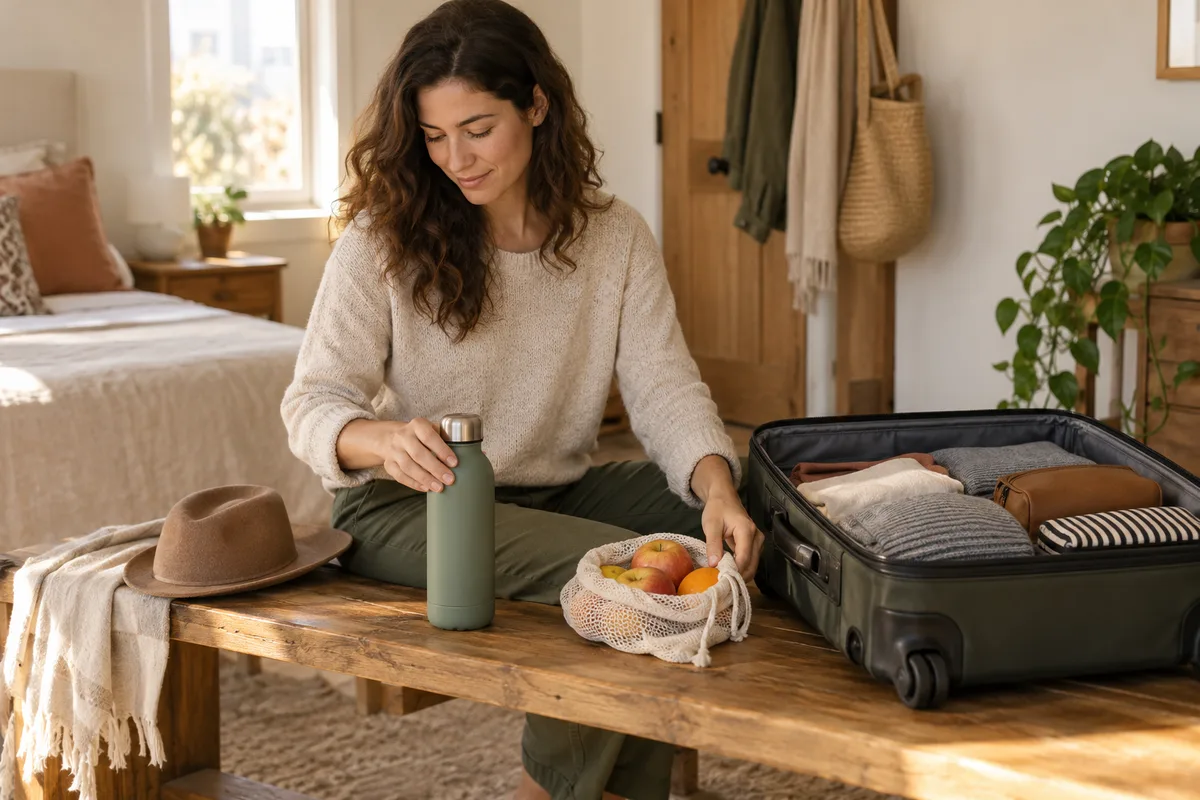
- Pack: a refillable bottle, a small bag of prunes or dried kiwi, and — if constipation is chronic and you’ll have a seated toilet — a foldable footstool.
During the trip:
- Drink proactively, not by thirst. A small glass every hour in flight; never restrict water to avoid the bathroom — holding urine hurts rhythm more than frequent trips.
- Protect breakfast. However tight the schedule, get a fiber-bearing breakfast (hotel oats, whole-grain bread, fruit) and hold a 10-minute bathroom window after it.
- Stand and move 2–3 minutes every hour. Walk the plane aisle; at road stops, actually walk — interrupting the sit matters.
- Don’t compromise on the toilet. First thing back at your lodging, give yourself a quiet bathroom opportunity; in public restrooms, headphones and a few slow breaths before starting — the pelvic floor needs a sense of safety to release.
- When the urge comes, go immediately — holding it costs more on the road than at home.

TCM methods
The five categories below are travel-executable, each marked with the constitution tendencies it suits. Everything in the food section is a food-therapy use of culinary ingredients; if you intend to use them as medicinal herbs, consult a licensed TCM practitioner.
Acupressure and self-massage
A travel-friendly point set — all doable seated, mid-flight or mid-ride. Fingertip pad, mild bearable ache:
- Zhigou (TE6): back of the forearm, four finger-widths above the wrist crease, between the two bones, 60 seconds per side. Traditionally the empirical constipation point — press a round every hour on long transits without leaving your seat.
- Zusanli (ST36): about four finger-widths below the outer knee hollow, one finger-width out from the shinbone, 60 seconds per side. Traditionally supports the Spleen and Stomach and restores from fatigue — right after travel’s drain.
- Neiguan (PC6): palm side of the forearm, three finger-widths above the wrist crease, between the two tendons, 60 seconds per side. Traditionally loosens the chest and settles the mind — the classic point for motion sickness and travel tension alike.
- Belly rub: back at your lodging, palm strokes along the colon’s path (lower right → upper right → upper left → lower left) for 5 minutes; direction matters. Full technique in how to massage your stomach.
Cautions: pregnant women should not press abdominal points or do the belly rub; stop if it hurts. Qi-deficiency leanings halve the pressure.
Food therapy
Chinese home-style track (packable; ingredients at Asian supermarkets or online before the trip):
- Toasted black sesame powder: a small bag in your luggage; one spoonful (about 10 g) stirred into congee or yogurt at breakfast. Traditionally moistens intestinal dryness — far more realistic than hunting fresh vegetables on the road.
- Red date and longan water: 3 red dates and 3 dried longans steeped in a thermos of hot water. Traditionally warms and replenishes qi and blood — the warm travel drink for yang- and qi-deficiency leanings, replacing iced cabin drinks.
- Chenpi water: 3 g dried tangerine peel (chenpi) steeped in hot water. Traditionally moves qi and supports the Spleen — for days when travel food chaos bloats you; go light if you run dry-mouthed.
Western everyday track:
- Prunes: the traditional travel answer — 5–6 a day, straight or soaked. Study doses are in the fruit article; halve if managing blood sugar.
- Instant oat cup: plain instant oats with hot water, steeped 5 minutes, plus hotel fruit. Protecting breakfast matters more than what’s in it — breakfast is the day’s most important gut signal.
Emotional care
For the bathroom-avoidant type, the core is rebuilding a sense of safety: schedule a “private bathroom appointment” back at your lodging — undisturbed, unhurried. In public restrooms, headphones block the environment and three slow belly breaths come before starting. Give yourself an explicit mental rule: the urge may return; a short-term change is not a failure. Use a bathroom when you feel comfortable and avoid prolonged straining. Qi-stagnation leanings can add a two-minute “tomorrow-not-thinking list” before bed: write the worries down and set them aside.
Movement
Travel exercise isn’t fitness — it’s gut stimulation maintenance: 2–3 minutes on your feet every hour, a 15–20 minute walk after arrival, and before bed, child’s pose and the supine twist for 5 breaths each — all doable in a hotel room. Yang-deficiency leanings keep warm after moving; yin-deficiency leanings don’t chase sweat.
Sleep and daily rhythm
- Cross-timezone trips: eat and sleep on local time immediately on arrival, and get daylight in the day — the faster the clock resets, the sooner the bathroom window returns; budget roughly a day per timezone crossed.
- Don’t compress sleep: late-night itinerary cramming is travel constipation’s multiplier.
- Breakfast happens no matter what: even five minutes — oats and fruit beat a sprint on an empty stomach, because breakfast is the gut’s key signal of the day.
Travel constipation checklist
Print or screenshot; check against it before departure:
Pack:
- Refillable water bottle (fill after security)
- A small bag of prunes or dried kiwi
- Toasted sesame powder or instant oat packets
- If chronically constipated: a foldable footstool
Every day of the trip:
- A real breakfast, with a 10-minute bathroom window after it
- One to two glasses of water above your normal intake (more on flight days)
- 2–3 minutes on your feet every hour
- The urge answered immediately, never deferred
- Zhigou and Zusanli, 60 seconds each side, before bed
After returning:
- Return to familiar meals and routines when practical; bowel habits may take different amounts of time to settle.
- Beyond a week unrecovered, follow the standard pathway in how long is too long without pooping.
How long recovery takes
- Short trips: bowel habits may return to usual after the trip; timing varies.
- Cross-timezone long hauls: sleep and routine changes may affect bowel habits; adjustment time varies.
- With a checklist: familiar routines may help reduce disruptions, though they cannot guarantee that travel-related constipation will be prevented.
More than a week unrecovered after return, or worse on every successive trip, means the baseline rhythm itself is fragile — build the everyday rhythm between trips instead of patching each trip.
When to see a doctor
- Persistent or severe abdominal pain, vomiting, fever, or inability to pass gas while traveling — get care where you are; don’t wait to be home;
- Blood in the stool or unexplained weight loss;
- Bowel movements not resumed more than a week after return, or travel constipation worsening trip over trip;
- Any bowel-habit change that outlasts the trip — don’t default-blame “the water,” especially if new after 40.
If you take medication that can cause constipation (opioid painkillers and others), plan travel constipation management with your doctor in advance. This article is general health education and can’t replace a doctor’s diagnosis or individualized advice.
Common questions
Why is flying worse than other travel?
Travel may change routine, activity, meals, and bathroom access, and some people drink less to avoid using the plane toilet. Unless you have been advised to restrict fluids, drink according to your usual needs and try to keep familiar routines. Effects vary by person.
Can I use a laxative as a travel emergency measure?
Occasional use of a gentle osmotic laxative (polyethylene glycol type) is common practice for travel, but ask a pharmacist or doctor first — especially for a first try, since dose, onset time, and the awkward scenario of “took a laxative and can’t find a toilet” all need planning. Laxatives don’t fix rhythm; rebuilding routine after the trip is still the point.
What about kids getting constipated on trips?
This article is for adults. Travel constipation in children is more common and more delicate — protect fluids and fruit, keep the toilet ritual familiar (fixed times, a familiar seat reducer), and if two or three days pass without a movement or the child is crying with abdominal pain, ask a pediatrician.
For the stress connection, read can stress make you constipated; for the fluid schedule, what to drink when constipated; the full framework is in the constipation hub.
Constipated on every trip? You can plan around it
How badly travel disrupts you depends on how strong your baseline rhythm is — the steadier the habit, the harder to knock over. The free constitution test shows your tendencies from a traditional wellness perspective, and pairs well with the trip checklist in this article. It's a self-observation tool, not a medical diagnosis.
References5 sources
- 01
U.S. National Institute of Diabetes and Digestive and Kidney Diseases (NIDDK / NIH)
- 02
U.S. National Institute of Diabetes and Digestive and Kidney Diseases (NIDDK / NIH)
- 03
UK National Health Service (NHS)
- 04
U.S. National Institute of Diabetes and Digestive and Kidney Diseases (NIDDK / NIH)
- 05
U.S. National Center for Complementary and Integrative Health (NCCIH / NIH)
Personalized guidance
Use the app for constitution-friendly ideas and structured plans when available.
Download the App
Get personalized TCM health recommendations